
Early in my coaching career, I made an observation: The best coaches seemed to be those who talked the least while still getting what they wanted out of a group of athletes. These coaches acted like facilitators, guiding athletes through a well-thought-out session plan while allowing room for exploration and mistakes to happen. This is in stark contrast to the brand of coaches who make themselves heard throughout the entirety of a session or attempt to correct every possible movement error with extensive dialogue.
…the best coaches acted like facilitators, guiding athletes through a well-thought-out session plan while allowing room for exploration and mistakes to happen, says @CoachGies. Share on XSome of these coaches I observed didn’t necessarily have the most detailed knowledge of sport science, possess an endless library of drills to choose from, or concoct fabulously detailed technical explanations for every movement problem—but their athletes seemed to be very engaged, moved well, and succeeded in their sport. I soon realized that simply knowing all of the technical models and fixes to every drill or being the most vocal—while obviously useful at certain moments—is only one piece of a larger puzzle for improving athletic performance.
Based on my experience shadowing these coaches, I understood that I needed to learn how to engage athletes and improve their athletic abilities, while keeping my coaching feedback to the minimum necessary to push them forward.
The ALTIS Virtual Apprentice Coach Program this past June was a fantastic learning experience. There were many great presenters, but Stu McMillan’s presentation on the “Art and Science of Speed for Team Sport” was particularly enlightening. He reminded me of some key models in motor learning that I had forgotten and introduced me to a few new ones. Some of these concepts included the Yerkes-Dodson Law, Newell’s three stages of learning, the challenge point framework, and how motor learning is embedded into our physical world. (For the sake of brevity, I will not dive into an explanation of each. However, I would encourage you to further explore these concepts.)
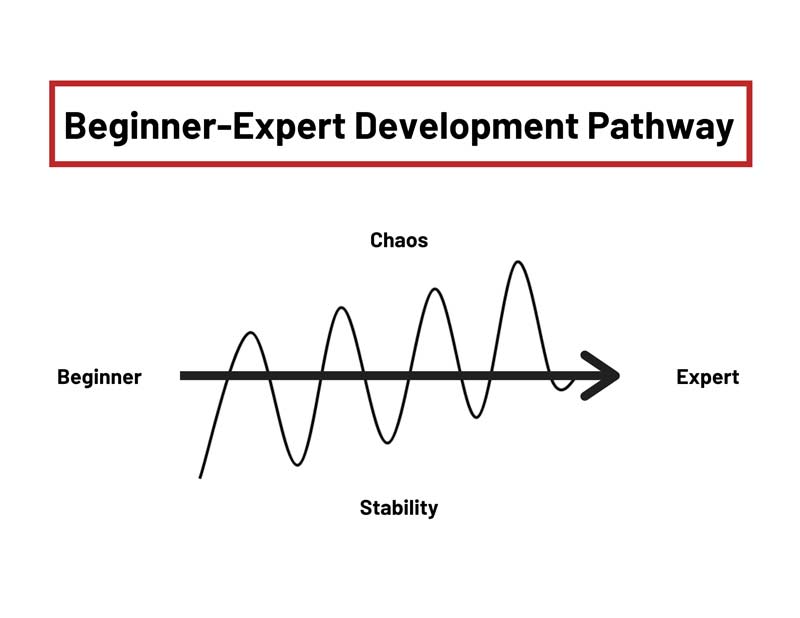
Now, in order for my simple brain to make sense of these concepts, I needed to come up with a straightforward way to view them. In essence, the previously mentioned motor learning models highlight what needs to happen as an athlete navigates the road toward expertise, or as I have conceptualized it, the Beginner-Expert Development Pathway (figure 1).
When learning a new skill, there need to be periods of stability to teach and solidify previous learning, as well as periods of chaos and uncertainty to challenge and expand learning. Share on XWhen learning a new skill, there need to be periods of stability to teach and solidify previous learning, as well as periods of chaos and uncertainty to challenge and expand learning. As an athlete’s skill set improves (moving toward expertise), the relative challenge of training elements should increase to stretch their abilities, while slightly reducing the frequency of stable and predictive elements, as the stimulus they provide diminishes as an athlete improves. A novice or developmental athlete needs to constantly navigate between stability and chaos to develop the physical, technical, tactical, and mental capacities necessary to successfully execute a specific task in a given environment.
The following are five key pillars that must occur to ensure an athlete moves along this pathway successfully:
My belief is that coaches who can implement these ideas effectively will be able to develop more skilled athletes in a wide variety of contexts…not just athletes proficient at a specific drill in training. These athletes will be able to successfully adapt and move in a wide variety of environments, which is ultimately what we want. However, I feel something gets lost in our profession among all of the articles and videos on new variations of drills, programming, and exercise selection: How do we actually coach an athlete through this process?
Coaching stable and predictable drills and exercises is fairly straightforward (notice I didn’t say easy!). Coaching the more chaotic elements while getting real development out of athletes, on the other hand, can be more difficult. This is what the coaches I was talking about at the beginning of this article did the best.
In a previous article, I argued that a games-based approach (GBA) can be an effective tool in an S&C coach’s arsenal and explained how athletic development not only includes physical abilities, but tactical, technical, and mental components as well (i.e., the Four Coactive Model of Player Preparation from Dr. Fergus Connolly and Cameron Josse). The question now is: How the heck can I, an S&C coach, implement games to effectively drive athletic development? I don’t just want kids playing random games; I’ve got movement patterns to teach! And isn’t all that fluffy stuff the job of the sports coach?

In traditional models of coaching,1 technique mastery is emphasized prior to game play. There is an emphasis on skill work in overly simplistic, pre-planned, and unpressurized situations that do not mimic the demands seen in a real game (sounds like some agility videos that go viral on social media). This will ultimately create a separation between technique and tactical knowledge, causing a disconnect between training and the game where players are not able to respond to relevant stimuli.
On the other hand, GBAs are an alternative means to contextualize learning within game-like activities (not to be confused with “free play,” although that can still be useful in certain instances). They were originally created to help PE teachers develop students’ tactical awareness to ultimately improve game performance. The coach acts more like a facilitator, using questions to promote player dialogue and reflection to guide the learning process….which was exactly what I saw in the best coaches I’ve observed!
The four common features of GBAs are:
The literature is also quite convincing in favor of GBAs, as highlighted by Kinnerk et al.’s review.1 It shows that in team sport environments, GBAs can improve tactical awareness and decision-making, while also increasing players’ affective domain development (the mental stuff, like emotions, feelings, and attitudes). If you’ve ever watched these types of games in action, you can see qualities such as anticipation, timing of runs, scanning, communication, energy system development, various starting positions, and short and long accelerations.
GBAs are fantastic opportunities to tie in multiple training elements for athletes to problem-solve, while increasing the transfer of your training programs to the sport itself.
As we look at how to incorporate GBAs in an S&C setting, we should ask the question: What are we actually trying to achieve with our athletes?
In my opinion, we as performance coaches are trying to develop skilled athletes who can rapidly read and react to environmental triggers with the correct movement solution. We are looking to improve not only physical capacities, but the technical, tactical, and mental pieces that allow an athlete’s physical abilities to be used to full effect.
When deciding which games work best, there really are no hard and fast rules. There are endless possibilities, and I’d encourage you to just sit and think about tweaking classic games to incorporate specific skills you are trying to target. I try to come up with a new game, or at least slight rule changes to my favorite games, almost every week with my athletes. I am always assessing where my athletes are on the Beginner-Expert Development Pathway and determining whether I need to increase chaos or increase stability.
I’d encourage you to just sit and think about tweaking classic games to incorporate specific skills you are trying to target, says @CoachGies. Share on XVariations of tag or ball games, with added twists or rule changes to target specific developmental areas, often produce the best results. These can be included at the beginning or end of sessions in 10-minute blocks as a fun warm-up or a way to tie in the technical components of the session. You can also use GBAs as a conditioning component or use a game as the entire training session…the possibilities are limitless.
Some examples of ways to alter traditional games include:
Notice how none of these examples center around how the athlete moves. Of course, you can address this when needed, but it is great to see athletes improve the way they move simply by changing the environmental constraints rather than through specific and direct coaching feedback. However, don’t simply add rules and leave it at that—to get the full effect from GBAs, we need to act as facilitators and use questioning and promote player dialogue. You need to ensure you step in at the right time and guide athletes to learn for themselves, while also stepping back and letting the athletes get on with it if you recognize they are being challenged appropriately.
It is great to see athletes improve the way they move simply by changing the environmental constraints rather than through specific and direct coaching feedback, says @CoachGies. Share on XSimilarly, you don’t need to over-coach and make the execution of the game “perfect,” as that could stunt the learning process. I try to stay as silent as possible (besides general encouragement) to see how athletes perform without constant coaching feedback. You’d be surprised how quickly an athlete improves simply through trial and error.
When a rule is added, or you notice players struggling with a concept or skill, bring them in to talk about it. The key is to use open-ended questions and get players to guide their own learning process.
By making players part of the problem-solving process, you will get more engagement, and the athletes will get better at working together. Often, I don’t even give a solution or correct them when they come up with something themselves—we just go with it and re-assess. Sometimes you will have to help them along a little more, especially with younger or more developmental athletes, but kids tend to be cleverer than we think. You can then see which athletes are more natural leaders and which ones might need more help in this area. Similarly, you can see which kids get overly frustrated or take it out on other players—then, you can have a private word or encourage them to be a better teammate and search for a solution rather than complaining.
When working with a group, I often implement the idea of “Start fast, finish fast”…similar to the concept of Play-Practice-Play. I tend to start a training session with a fast-paced GBA to get kids dialed in right away, spend the middle portion working on more traditional training (drills, linear sprints/jumps), and finish with another fast-paced GBA to contextualize the technical components while making sure kids leave excited and beg their parents to come back next week. Based on the intended outcomes of the session or the needs of the particular athlete(s), the activities and games I select will help me create the environment needed to develop those particular goals. During the middle of a session, I can spend time doing drills and more technical pieces to reinforce what I want out of the games, but this is much easier to do when the kids are excited and having fun throughout the session because of a fast start.
The possibilities are endless in terms of the games you can implement, and the key is guiding your athletes along the Beginner-Expert Development Pathway, with the game as a tool to achieve this. Now that I’ve (hopefully) justified the utility of GBAs in an S&C context, I’d like to share a particularly fun game I use regularly.
I often come up with silly names for the games we play. The city I’m based out of, Chestermere (Alberta, Canada), is the inspiration for the name Chesty Ball. It is a variation of basketball and can be played either full court or half court (or even smaller), but it is especially good when played on the mini courts at middle schools. We play with a volleyball, but any ball will do.
There are several levels for scoring points:
We introduce this game initially with no running with the ball (just pivoting) and turnovers only if the ball is intercepted or goes out of bounds. Once athletes understand the basics, we introduce running with the ball and other rules to speed up decision-making and gameplay. This scoring system allows players of all abilities the chance to score and contribute to the team’s success, as well as offering high-reward scoring options, but the point penalty for missing ensures players will still be strategic and not just try to kick the ball endlessly. Awesome game, especially when you add new scoring options and other rules.
As you can see, this game incorporates physical (fitness, linear and multidirectional accelerations, jumping), technical (passing, catching, throwing, body control), tactical (coming up with game plan, reacting to your own players and opponents, responding to new rule changes), and mental elements (composure, communication). More importantly, you don’t need to coach any particular element too much. You set the parameters of the game, implement various rules, and let the athletes go. You then facilitate learning through targeted questioning to ensure the goals of the session are being achieved. To me, this seems like the optimal environment to develop actual athletes, not just kids who can perform in the weight room or repeat a drill.
This article is not an attack on current coaching practices. My goal is to have you reflect on your own session plans and coaching behaviors during those sessions and ask:
Of course, you need to spend time breaking down skills and developing specific movement patterns in a controlled and stable environment. But by understanding the motor development process and how an athlete moves from a beginner to a skilled performer, you will understand the need for chaotic elements that challenge and stretch an athlete’s learning ability.
GBAs allow a coach to incorporate multiple components of athletic development while contextualizing learning into more realistic scenarios, says @CoachGies. Share on XGBAs allow a coach to incorporate multiple components of athletic development while contextualizing learning into more realistic scenarios. By acting as a facilitator, you will foster reflection and learning on a deeper level, while creating a fun and enjoyable experience for your athletes.
Kinnerk, P., Harvey, S., MacDonncha, C., and Lyons, M. “A review of the game-based approaches to coaching literature in competitive team sport settings.” Quest. 2018;70(4):401-418.

In his quest to engage athletes and improve their abilities while keeping his coaching feedback to a minimum, Coach Gies has fine-tuned a games-based athletic training model. Here, he explains how to successfully design and implement a GBA for your own athletes.
Early in my coaching career, I made an observation: The best coaches seemed to be those who talked the least while still getting what they wanted out of a group of athletes. These coaches acted like facilitators, guiding athletes through a well-thought-out session plan while allowing room for exploration and mistakes to happen. This is in stark contrast to the brand of coaches who make themselves heard throughout the entirety of a session or attempt to correct every possible movement error with extensive dialogue.
…the best coaches acted like facilitators, guiding athletes through a well-thought-out session plan while allowing room for exploration and mistakes to happen, says @CoachGies. Share on XSome of these coaches I observed didn’t necessarily have the most detailed knowledge of sport science, possess an endless library of drills to choose from, or concoct fabulously detailed technical explanations for every movement problem—but their athletes seemed to be very engaged, moved well, and succeeded in their sport. I soon realized that simply knowing all of the technical models and fixes to every drill or being the most vocal—while obviously useful at certain moments—is only one piece of a larger puzzle for improving athletic performance.
Based on my experience shadowing these coaches, I understood that I needed to learn how to engage athletes and improve their athletic abilities, while keeping my coaching feedback to the minimum necessary to push them forward.
The ALTIS Virtual Apprentice Coach Program this past June was a fantastic learning experience. There were many great presenters, but Stu McMillan’s presentation on the “Art and Science of Speed for Team Sport” was particularly enlightening. He reminded me of some key models in motor learning that I had forgotten and introduced me to a few new ones. Some of these concepts included the Yerkes-Dodson Law, Newell’s three stages of learning, the challenge point framework, and how motor learning is embedded into our physical world. (For the sake of brevity, I will not dive into an explanation of each. However, I would encourage you to further explore these concepts.)
Now, in order for my simple brain to make sense of these concepts, I needed to come up with a straightforward way to view them. In essence, the previously mentioned motor learning models highlight what needs to happen as an athlete navigates the road toward expertise, or as I have conceptualized it, the Beginner-Expert Development Pathway (figure 1).
When learning a new skill, there need to be periods of stability to teach and solidify previous learning, as well as periods of chaos and uncertainty to challenge and expand learning. Share on XWhen learning a new skill, there need to be periods of stability to teach and solidify previous learning, as well as periods of chaos and uncertainty to challenge and expand learning. As an athlete’s skill set improves (moving toward expertise), the relative challenge of training elements should increase to stretch their abilities, while slightly reducing the frequency of stable and predictive elements, as the stimulus they provide diminishes as an athlete improves. A novice or developmental athlete needs to constantly navigate between stability and chaos to develop the physical, technical, tactical, and mental capacities necessary to successfully execute a specific task in a given environment.
The following are five key pillars that must occur to ensure an athlete moves along this pathway successfully:
My belief is that coaches who can implement these ideas effectively will be able to develop more skilled athletes in a wide variety of contexts…not just athletes proficient at a specific drill in training. These athletes will be able to successfully adapt and move in a wide variety of environments, which is ultimately what we want. However, I feel something gets lost in our profession among all of the articles and videos on new variations of drills, programming, and exercise selection: How do we actually coach an athlete through this process?
Coaching stable and predictable drills and exercises is fairly straightforward (notice I didn’t say easy!). Coaching the more chaotic elements while getting real development out of athletes, on the other hand, can be more difficult. This is what the coaches I was talking about at the beginning of this article did the best.
In a previous article, I argued that a games-based approach (GBA) can be an effective tool in an S&C coach’s arsenal and explained how athletic development not only includes physical abilities, but tactical, technical, and mental components as well (i.e., the Four Coactive Model of Player Preparation from Dr. Fergus Connolly and Cameron Josse). The question now is: How the heck can I, an S&C coach, implement games to effectively drive athletic development? I don’t just want kids playing random games; I’ve got movement patterns to teach! And isn’t all that fluffy stuff the job of the sports coach?
In traditional models of coaching,1 technique mastery is emphasized prior to game play. There is an emphasis on skill work in overly simplistic, pre-planned, and unpressurized situations that do not mimic the demands seen in a real game (sounds like some agility videos that go viral on social media). This will ultimately create a separation between technique and tactical knowledge, causing a disconnect between training and the game where players are not able to respond to relevant stimuli.
On the other hand, GBAs are an alternative means to contextualize learning within game-like activities (not to be confused with “free play,” although that can still be useful in certain instances). They were originally created to help PE teachers develop students’ tactical awareness to ultimately improve game performance. The coach acts more like a facilitator, using questions to promote player dialogue and reflection to guide the learning process….which was exactly what I saw in the best coaches I’ve observed!
The four common features of GBAs are:
The literature is also quite convincing in favor of GBAs, as highlighted by Kinnerk et al.’s review.1 It shows that in team sport environments, GBAs can improve tactical awareness and decision-making, while also increasing players’ affective domain development (the mental stuff, like emotions, feelings, and attitudes). If you’ve ever watched these types of games in action, you can see qualities such as anticipation, timing of runs, scanning, communication, energy system development, various starting positions, and short and long accelerations.
GBAs are fantastic opportunities to tie in multiple training elements for athletes to problem-solve, while increasing the transfer of your training programs to the sport itself.
As we look at how to incorporate GBAs in an S&C setting, we should ask the question: What are we actually trying to achieve with our athletes?
In my opinion, we as performance coaches are trying to develop skilled athletes who can rapidly read and react to environmental triggers with the correct movement solution. We are looking to improve not only physical capacities, but the technical, tactical, and mental pieces that allow an athlete’s physical abilities to be used to full effect.
When deciding which games work best, there really are no hard and fast rules. There are endless possibilities, and I’d encourage you to just sit and think about tweaking classic games to incorporate specific skills you are trying to target. I try to come up with a new game, or at least slight rule changes to my favorite games, almost every week with my athletes. I am always assessing where my athletes are on the Beginner-Expert Development Pathway and determining whether I need to increase chaos or increase stability.
I’d encourage you to just sit and think about tweaking classic games to incorporate specific skills you are trying to target, says @CoachGies. Share on XVariations of tag or ball games, with added twists or rule changes to target specific developmental areas, often produce the best results. These can be included at the beginning or end of sessions in 10-minute blocks as a fun warm-up or a way to tie in the technical components of the session. You can also use GBAs as a conditioning component or use a game as the entire training session…the possibilities are limitless.
Some examples of ways to alter traditional games include:
Notice how none of these examples center around how the athlete moves. Of course, you can address this when needed, but it is great to see athletes improve the way they move simply by changing the environmental constraints rather than through specific and direct coaching feedback. However, don’t simply add rules and leave it at that—to get the full effect from GBAs, we need to act as facilitators and use questioning and promote player dialogue. You need to ensure you step in at the right time and guide athletes to learn for themselves, while also stepping back and letting the athletes get on with it if you recognize they are being challenged appropriately.
It is great to see athletes improve the way they move simply by changing the environmental constraints rather than through specific and direct coaching feedback, says @CoachGies. Share on XSimilarly, you don’t need to over-coach and make the execution of the game “perfect,” as that could stunt the learning process. I try to stay as silent as possible (besides general encouragement) to see how athletes perform without constant coaching feedback. You’d be surprised how quickly an athlete improves simply through trial and error.
When a rule is added, or you notice players struggling with a concept or skill, bring them in to talk about it. The key is to use open-ended questions and get players to guide their own learning process.
By making players part of the problem-solving process, you will get more engagement, and the athletes will get better at working together. Often, I don’t even give a solution or correct them when they come up with something themselves—we just go with it and re-assess. Sometimes you will have to help them along a little more, especially with younger or more developmental athletes, but kids tend to be cleverer than we think. You can then see which athletes are more natural leaders and which ones might need more help in this area. Similarly, you can see which kids get overly frustrated or take it out on other players—then, you can have a private word or encourage them to be a better teammate and search for a solution rather than complaining.
When working with a group, I often implement the idea of “Start fast, finish fast”…similar to the concept of Play-Practice-Play. I tend to start a training session with a fast-paced GBA to get kids dialed in right away, spend the middle portion working on more traditional training (drills, linear sprints/jumps), and finish with another fast-paced GBA to contextualize the technical components while making sure kids leave excited and beg their parents to come back next week. Based on the intended outcomes of the session or the needs of the particular athlete(s), the activities and games I select will help me create the environment needed to develop those particular goals. During the middle of a session, I can spend time doing drills and more technical pieces to reinforce what I want out of the games, but this is much easier to do when the kids are excited and having fun throughout the session because of a fast start.
The possibilities are endless in terms of the games you can implement, and the key is guiding your athletes along the Beginner-Expert Development Pathway, with the game as a tool to achieve this. Now that I’ve (hopefully) justified the utility of GBAs in an S&C context, I’d like to share a particularly fun game I use regularly.
I often come up with silly names for the games we play. The city I’m based out of, Chestermere (Alberta, Canada), is the inspiration for the name Chesty Ball. It is a variation of basketball and can be played either full court or half court (or even smaller), but it is especially good when played on the mini courts at middle schools. We play with a volleyball, but any ball will do.
There are several levels for scoring points:
We introduce this game initially with no running with the ball (just pivoting) and turnovers only if the ball is intercepted or goes out of bounds. Once athletes understand the basics, we introduce running with the ball and other rules to speed up decision-making and gameplay. This scoring system allows players of all abilities the chance to score and contribute to the team’s success, as well as offering high-reward scoring options, but the point penalty for missing ensures players will still be strategic and not just try to kick the ball endlessly. Awesome game, especially when you add new scoring options and other rules.
As you can see, this game incorporates physical (fitness, linear and multidirectional accelerations, jumping), technical (passing, catching, throwing, body control), tactical (coming up with game plan, reacting to your own players and opponents, responding to new rule changes), and mental elements (composure, communication). More importantly, you don’t need to coach any particular element too much. You set the parameters of the game, implement various rules, and let the athletes go. You then facilitate learning through targeted questioning to ensure the goals of the session are being achieved. To me, this seems like the optimal environment to develop actual athletes, not just kids who can perform in the weight room or repeat a drill.
This article is not an attack on current coaching practices. My goal is to have you reflect on your own session plans and coaching behaviors during those sessions and ask:
Of course, you need to spend time breaking down skills and developing specific movement patterns in a controlled and stable environment. But by understanding the motor development process and how an athlete moves from a beginner to a skilled performer, you will understand the need for chaotic elements that challenge and stretch an athlete’s learning ability.
GBAs allow a coach to incorporate multiple components of athletic development while contextualizing learning into more realistic scenarios, says @CoachGies. Share on XGBAs allow a coach to incorporate multiple components of athletic development while contextualizing learning into more realistic scenarios. By acting as a facilitator, you will foster reflection and learning on a deeper level, while creating a fun and enjoyable experience for your athletes.
Kinnerk, P., Harvey, S., MacDonncha, C., and Lyons, M. “A review of the game-based approaches to coaching literature in competitive team sport settings.” Quest. 2018;70(4):401-418.
You must be logged in to post a comment.