
Visit our Store

Trusted by professional athletes worldwide, 1080 Motion helps you maximize performance with cutting-edge resistance training technology.
Shop Now

The Ultimate Hamstring Exercise Guide

The Ultimate Hamstring Exercise Guide
Share this

In this Article

Summary

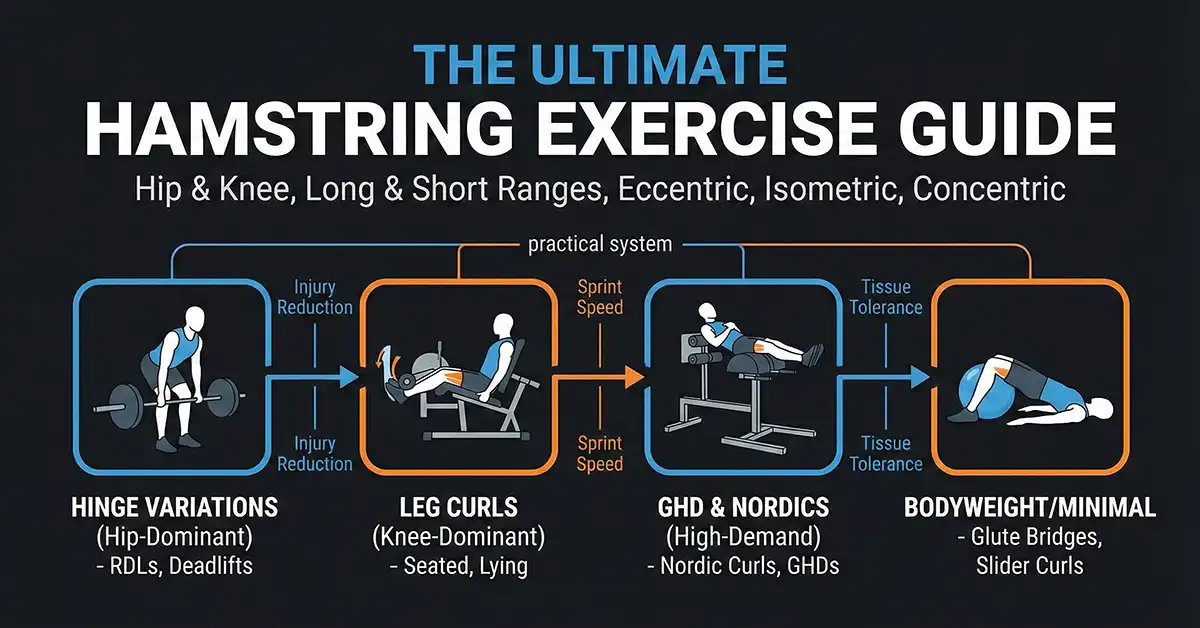
Hamstrings are critical for sprinting, deceleration, and injury reduction, yet they remain one of the most poorly programmed muscle groups in sport. Discover how to move beyond basic deadlifts and train the hamstrings the way they function in competition through long and short ranges, hip and knee dominance, and varied contraction types.

Hamstrings remain one of the most discussed muscle groups in sport, yet one of the most poorly programmed.

Most coaches understand why hamstrings matter. Sprinting speed, deceleration, change of direction, and injury reduction all depend on them. Yet programming often defaults to a small handful of exercises, used year-round, with little thought to joint action, muscle length, or contraction type.

That approach leaves performance on the table.

Effective hamstring development means training them the way they function in sport: at the hip and knee, through long and short ranges, and under eccentric, isometric, and concentric demands.

In the pages ahead, I break down each major category of hamstring training, why it matters, and how to progress it with tempo, pauses, and accommodating resistance. By the end, you will have a clear, academic understanding and a practical system you can plug straight into your coaching.

Hinge Variations (Hip-Dominant Hamstring Training)

Hinge-based exercises train the hamstrings primarily as hip extensors. This mimics how they function during acceleration, upright sprinting, and braking mechanics.

These movements load the hamstrings proximally and typically allow the greatest absolute loading, making them a cornerstone of any long-term hamstring development plan. If you want athletes who can apply force into the ground and tolerate high sprint volumes, hinge work must be present year-round in some form.

Trap Bar/Barbell Deadlift

The deadlift trains the hamstrings as powerful hip extensors under high external load while coordinating force production across the posterior chain.

The athlete begins with the barbell positioned over the midfoot and the hips set back with a neutral spine. From this position, the athlete extends the hips and knees simultaneously to lift the bar from the floor, maintaining tension through the hamstrings and glutes as the bar travels vertically.

The athlete completes the lift once the hips are fully extended and they stand tall, followed by a controlled descent back to the floor to initiate the next repetition. Reserve this movement for phases where absolute strength development and tissue tolerance are prioritized.

Use deadlifts to:

  • Build absolute strength
  • Increase tissue tolerance
  • Develop general force capacity in the offseason

Deadlifts set the table. They don’t finish the meal.

Trap Bar/Barbell Romanian Deadlift (RDL)

The barbell Romanian deadlift emphasizes long-length hamstring loading through controlled hip hinging with minimal knee flexion.

The athlete begins standing tall with the barbell held at the hips. From this position, the athlete pushes the hips back while maintaining a neutral spine, allowing the bar to travel down the thighs and shins until they achieve maximal hamstring tension.

Keep the descent controlled throughout. After reaching the bottom, the athlete reverses the movement by driving the hips forward to return to the starting position. The RDL is particularly effective for improving hamstring length tolerance; perform the RDL with intent rather than maximal load.

RDLs are ideal for:

  • Sprint-based athletes
  • Hypertrophy and strength with intent
  • Phases prioritizing injury reductions

Few exercises deliver as much value per rep when coached well.

Common issues with these hinge variations include:

  • Lack of upper back strength and hypertrophy leading to a rounded spine
  • Lateral shifts of the hips from right to left (unilateral imbalance)
  • Lack of coordination under load

While these errors are common, you can fix them through proper programming of volume and intensity, corrective movements in the early offseason, and tempo training during unilateral variations covered later in this article.

Coach’s Note on the Sumo Deadlift Variation:

While the hamstrings play a role in the sumo deadlift, I added it to the list as a special note. Many coaches misunderstand this hinge variation as a “lesser” posterior chain lift, but it remains an effective way to train the hamstrings and glutes while significantly reducing stress on the lumbar spine.

The wider stance and more upright torso shorten the moment arm at the low back, allowing athletes to load their hips without excessive spinal shear. While the hamstrings do not move through as long a length as in an RDL, they still contribute meaningfully to hip extension—particularly in the initial pull off the floor—alongside a strong glute and adductor demand.

For athletes with a history of low back issues, high sprint volumes, or heavy spinal loading elsewhere in the program, the sumo deadlift provides a valuable option to maintain posterior chain strength without accumulating unnecessary lumbar fatigue.

Stagger Stance RDL

The stagger stance RDL introduces unilateral bias while maintaining stability and load.

The athlete begins standing with one foot slightly behind the other, keeping the majority of bodyweight over the front leg. From this position, the athlete hinges at the hips, allowing the bar to descend under control while maintaining a neutral spine and fixed knee angle on the lead leg.

Once the athlete reaches maximal controllable hamstring tension, they extend the hips to return to the starting position. Use this variation to address asymmetries while limiting balance constraints.

This movement is best used for:

  • Athletes with asymmetries
  • Transitional phases (rehab to performance)
  • Field sport populations looking to reduce load while maintaining athletic qualities in-season or earlier in the offseason

Single-Leg RDL

The single-leg RDL challenges unilateral hip extension, pelvic control, and hamstring loading at long muscle lengths.

The athlete begins standing on one leg with the opposite leg extended behind the body. From this position, the athlete hinges at the hip of the stance leg, allowing the torso to move forward while the free leg extends backward in line with the trunk.

The descent continues until the athlete achieves maximal hamstring tension without loss of position, after which the athlete extends the hip to return to standing. This variation should prioritize control, range, and tempo over external load.

See here:

Best used for:

  • Field and court athletes
  • Return-to-play progressions
  • Anti-rotation and pelvic control work
  • Athletes with lumbar spine issues that still need to train the hinge pattern

Common Issues in Single-Leg Hinge-Based Training

Single-leg hinge variations are highly effective but easy to execute poorly when load, fatigue, or intent are mismanaged. Small technical errors at the pelvis, trunk, or stance leg can quickly shift stress away from the hamstrings and reduce the value of the movement.

Identifying these issues early allows coaches to keep unilateral hinge work both effective and safe.

Most Common Errors

  • Pelvic rotation toward the non-working leg: The pelvis opens as the athlete hinges, shifting load away from the stance-side hamstrings and increasing lumbar contribution.
  • Excessive knee bend in the stance leg: The movement turns into a single-leg squat, reducing long-length hamstring tension.
  • Loss of trunk position: Excessive spinal flexion or rotation replaces true hip hinging as load increases.
  • Poor foot and balance control: Toe gripping, rolling onto the outside of the foot, or frequent foot taps from the non-working leg.
  • Rushed or uncontrolled eccentric: The athlete drops into the bottom position, bypassing the long-length eccentric stimulus.

Correctives and Coaching Solutions

For pelvic rotation:

  • Use contralateral loading (load in the opposite hand of the stance leg).
  • Add front-facing or wall-referenced hinges to provide external feedback.
  • Cue “hips stay square to the floor” throughout the descent.

For excessive knee bend:

  • Prescribe soft-knee but fixed-angle cues.
  • Regress to kickstand or staggered-stance RDLs.
  • Use tempo-controlled eccentrics to reinforce hip-driven motion.

For loss of trunk position:

  • Reduce load and emphasize spine-long, chest-down hinge cues.
  • Add iso-hold pauses just off the bottom position.
  • Pair with anti-rotation trunk work earlier in the session.

For poor foot and balance control:

  • Coach tripod foot contact (heel, big toe, little toe).
  • Start with rear-toe support or dowel-assisted balance.
  • Limit range of motion until control improves.

For rushed eccentrics:

  • Prescribe 4–6 second eccentric tempos.
  • Use pause-at-end-range repetitions.
  • Reduce load and prioritize time under tension over weight.

Machine-Based Leg Curl Variations (Knee-Dominant Hamstring Training)

While hinge patterns get most of the attention, knee-dominant hamstring strength is just as critical, especially for sprinting and injury reduction. Leg curls train the hamstrings distally as knee flexors, which is essential for late-swing sprint mechanics and knee stability.

They may not look “athletic,” but they are non-negotiable in well-rounded programs.

Seated Leg Curl

The seated leg curl trains the hamstrings through knee flexion while placing the muscle in a lengthened position due to hip flexion.

The athlete begins seated with the hips fully back against the pad and the knees aligned with the machine’s axis of rotation. From this position, the athlete flexes the knees to pull the pad downward under control, maintaining contact with the seat and minimizing trunk movement.

Once reaching peak knee flexion, the athlete pauses briefly before extending the knees back to the starting position under control. The seated leg curl is particularly effective for long-length hamstring loading and injury-reduction focused training blocks.

This movement is best used for:

  • Sprint athletes
  • Injury reduction blocks
  • High-volume exposure with minimal spinal fatigue
  • Removing imbalances on single-leg variations

Single-Single-Double Seated Leg Curl

The single-single-double seated leg curl uses a sequencing approach to overload one limb while maintaining overall volume.

The athlete performs one repetition with the right leg, one repetition with the left leg, followed by one repetition using both legs simultaneously. Perform each repetition with controlled tempo and full range of motion.

This variation allows for increased time under tension and fatigue accumulation without excessive loading.

Standing Single-Leg Curl

The standing single-leg leg curl introduces knee flexion training in an upright position, increasing demands on pelvic control and posture.

The athlete begins standing with the working leg positioned against the pad and the torso upright. From this position, the athlete flexes the knee under control, pauses briefly at peak contraction, and returns to the starting position while maintaining balance and trunk position.

This variation reinforces posture and unilateral control.
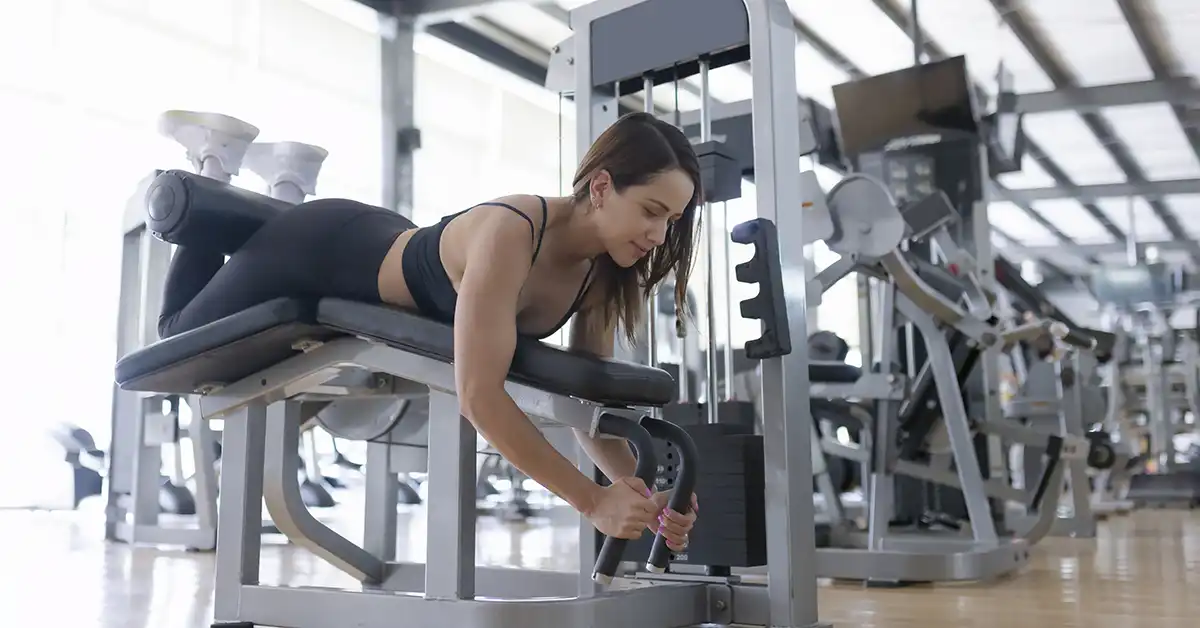
Leg Curl

Lying Leg Curl

The lying leg curl trains knee flexion with the hips in a more extended position, placing the hamstrings at a shorter muscle length compared to seated variations.

The athlete begins lying prone on the machine with the knees aligned to the axis of rotation and the pad positioned just above the heels. From this position, the athlete flexes the knees to curl the pad upward under control, pauses briefly at the top, and lowers the load back to the starting position.

This variation allows for heavier loading and simpler execution.

Use the lying leg curl when:

  • You want higher loads
  • You are managing fatigue
  • You are late in a session
  • You need to remove imbalances on single-leg variations

Athletes encounter fewer issues with machine-based leg curls because the fixed path and external support reduce balance and coordination demands. When problems do occur, they usually relate to setup: poor seat position, misaligned knees, or loss of pad contact rather than flaws in execution. Correcting positioning typically restores the intended hamstring stimulus.

GHD & Nordic Variations (High-Demand Hamstring Training)

GHDs and Nordics expose the hamstrings to extreme eccentric stress and represent the highest-risk, highest-reward category of hamstring training.

These movements demand technical proficiency, gradual progression, and careful volume management. When applied correctly, they are among the most effective tools for reducing sprint-related hamstring injuries.

Full GHD

The full GHD challenges both hip extension and knee flexion through large ranges of motion. Reserve this for athletes with sufficient strength and control.

The athlete starts at the downward phase of the back extension and holds a 1–2 second isometric pause at the end range of the back extension.

After completing the first “bottom half” of the movement, the athlete ascends to an almost full upright position (typically where the athlete’s head is in line with the 11 o’clock position). Hold the position at the top for 1–2 seconds, then proceed to the halfway point of the back extension for 1–2 seconds.

Lastly, the athlete finishes the movement by bringing their head to the floor to start the first “bottom half” of the movement again before the next repetition.

See the example below:

Top-Half GHD

The top-half GHD challenges hip extension while limiting total range of motion, allowing athletes to accumulate high-quality hamstring loading with reduced lumbar stress. This variation is appropriate for athletes building capacity toward full-range GHDs or when you must carefully manage volume and tissue tolerance.

The athlete starts in the back extension position and initiates the movement by extending the hips to raise the torso to an almost full upright position, typically where the head is in line with the 11 o’clock position.

The athlete holds this top position for 1–2 seconds before descending under control back to the back extension position and holding for an additional 1–2 seconds. The athlete repeats this top-half sequence for the prescribed number of repetitions, maintaining tension and control throughout.

See the example below:

Nordic Leg Curl

The Nordic leg curl challenges the hamstrings through maximal eccentric knee flexion and is one of the most well-supported exercises for reducing sprint-related hamstring injuries. Progress this movement gradually over months, not weeks, to allow adequate tissue adaptation.

The athlete begins in a tall kneeling position with the ankles secured and the hips fully extended. From this position, the athlete slowly lowers the torso toward the floor under control, maintaining a straight line from the knees through the shoulders.

The descent should remain controlled throughout, emphasizing eccentric hamstring tension, until the athlete reaches their maximal controllable range. At this point, the athlete uses the hands to assist back to the starting position or reset for the next repetition, maintaining quality and intent on each repetition.

See video: Nordic Curl (Barbell Modification)

Razor Nordic Leg Curl

The razor Nordic leg curl builds on the traditional Nordic by integrating hip extension, increasing the complexity and overall hamstring demand. This advanced variation bridges hinge and curl mechanics and requires well-trained athletes with sufficient eccentric strength and trunk control.

The athlete begins in the same tall kneeling position with the ankles secured and hips extended. As the athlete lowers under control, they actively maintain hip extension, keeping the torso rigid and aligned.

Upon reaching the lowest controllable position, the athlete initiates the return by extending through the hips and contracting the hamstrings to raise the torso back toward the starting position, minimizing upper-body assistance. This coordinated knee flexion and hip extension demand places a higher eccentric and concentric load on the hamstrings. Introduce it conservatively.

Hamstring – Razor Curl (Eccentric Only)

Common Issues with GHD & Nordic Variations

GHD and Nordic-based exercises place the hamstrings under extreme eccentric stress, which is precisely why they are so effective. It is also why they break down quickly when you mismanage progression, volume, or intent.

The most common issues occur when athletes lack the eccentric strength or positional control required to handle long-length loading. This leads to compensations that shift stress away from the hamstrings and toward the lumbar spine or surrounding tissues.

Most Common Issues

  • Excessive lumbar extension or spinal compensation: Athletes hinge through the low back rather than controlling hip and knee extension, especially near end range.
  • Loss of eccentric control: The descent accelerates as athletes approach failure, turning controlled eccentrics into uncontrolled drops.
  • Poor range-of-motion selection: Athletes perform full-range variations before earning the capacity to control partial or top-half positions.

Corrective Strategies and Coaching Solutions

For lumbar compensation:

  • Regress to top-half GHDs or assisted Nordics.
  • Cue “ribs down” and maintain neutral spine throughout the movement.

For loss of eccentric control:

  • Prescribe 3–6 second controlled eccentrics.
  • Reduce total reps per set and prioritize quality over volume.

For inappropriate range selection:

  • Build capacity using partial ranges and isometric holds.
  • Progress range of motion gradually before increasing load or volume.

Hamstring Options Without Machines

Not every environment has access to leg curl machines or GHDs. That shouldn’t limit hamstring development. Bodyweight and minimal-equipment options can still provide meaningful eccentric exposure when programmed correctly.

Physio Ball Leg Curl Variations (Bilateral and Single-Leg)

Physio ball leg curl variations combine knee flexion with active hip extension, making them effective entry-level hamstring exercises and useful in rehab, early offseason, or low-equipment settings.

The athlete begins in a supine bridge position with the heels on the ball and hips fully extended, rolling the ball toward the body under control before returning to the start while maintaining trunk and pelvic stability.

The single-leg variation increases unilateral demand by removing one point of contact, requiring greater hip and trunk control without adding external load.

See the example below:

Reasons to Use These Variations:

  • Train knee flexion while maintaining hip extension
  • Build trunk and pelvic control
  • Progress from bilateral to unilateral loading

Slider Leg Curl Variations (Bilateral and Single-Leg)

Slider leg curl variations place the hamstrings under long-lever eccentric stress while requiring active hip extension, making them one of the most effective low-equipment hamstring options available.

The athlete begins in a supine bridge position with the heels on sliders or a roller and the hips fully extended, slowly extending the knees to slide the heels away from the body before returning to the starting position under control.

The single-leg variation increases eccentric demand and control requirements by loading one limb at a time, significantly raising hamstring stress without external load.

See here!

Reasons to Use These Variations:

  • Maintain hip extension under increasing lever demands
  • Provide scalable progressions from bilateral to unilateral work
  • Serve as effective alternatives to Nordic variations with minimal equipment

Common Issues with Hamstring Options Without Machines

Coaches often underestimate bodyweight and minimal-equipment hamstring exercises, but they expose technical and strength limitations quickly when positional control or fatigue breaks down. The most common issues tend to be consistent across physio ball and slider-based variations and directly impact the intended hamstring stimulus.

Most Common Issues

  • Loss of hip extension: The pelvis drops as the legs extend, shifting load away from the hamstrings and into the low back.
  • Rushed or uncontrolled eccentrics: Athletes slide out quickly to avoid long-length hamstring tension, bypassing the primary training stimulus.
  • Reduced or inconsistent range of motion: Reps become shorter over time as fatigue sets in, limiting effective eccentric exposure.

Corrective Strategies and Coaching Solutions

For loss of hip extension:

  • Cue “hips tall” or “belt buckle up” throughout the set.
  • Regress to bilateral variations or add short-range isometric bridge holds.

For rushed eccentrics:

  • Prescribe 4–8 second eccentric tempos.
  • Use pause-at-end-range repetitions to reinforce control.

For reduced range of motion:

  • Shorten the range intentionally and rebuild full range gradually.
  • Cap sets early to preserve quality and intent.

Glute Bridge Variations (Posterior Chain Lock-In)

Although glute bridges are often categorized as “glute” exercises, the hamstrings play a critical stabilizing role, especially during isometric and unilateral variations. These exercises help reinforce hip extension strength without excessive spinal loading.

Glute Bridge Variations (Bilateral, Unilateral, and Banded)

Glute bridge variations train hip extension while minimizing axial and lumbar stress, making them useful across all phases of training.

The athlete begins with the upper back supported on a bench and load positioned across the hips, driving through the heels to extend the hips to full lockout before lowering under control. Bilateral variations allow heavier loading, while single-leg and banded options increase unilateral demand, hamstring co-contraction, and posterior chain stiffness without requiring excessive external load.

See below: Barbell Glute Bridge

Reasons to Use These Variations:

  • Load hip extension with minimal spinal stress
  • Reinforce glute and hamstring co-contraction
  • Progress from bilateral to unilateral control
  • Accumulate time under tension with tempo or isometrics
  • Use accommodating resistance to strengthen lockout positions

Common Issues with Glute Bridge Variations

Glute bridge exercises are well tolerated, but technical breakdowns still occur, particularly when load, volume, or fatigue are mismanaged. Most issues stem from loss of hip extension quality or compensations that shift stress away from the intended posterior chain musculature.

Most Common Issues

  • Lumbar extension at lockout: Athletes finish the movement by arching the low back rather than extending through the hips.
  • Incomplete hip extension: Reps are cut short, limiting glute and hamstring engagement at lockout.
  • Uneven pelvic position in unilateral variations: The pelvis shifts or drops during single-leg bridges, reducing force output from the working side.
  • Loss of tension between repetitions: Athletes relax at the bottom, turning the movement into disconnected reps rather than continuous posterior chain loading.

Corrective Strategies and Coaching Solutions

For lumbar extension at lockout:

  • Cue “ribs down” and “finish with the hips, not the low back.”
  • Add 1–3 second isometric holds at true hip lockout.

For incomplete hip extension:

  • Reduce load and emphasize full lockout with pauses.
  • Use banded variations to reinforce top-end tension.

For pelvic shift in unilateral work:

  • Regress to bilateral or kickstand variations.
  • Use hands-on-hips or mirror feedback to maintain pelvic alignment.

For loss of tension between reps:

  • Prescribe tempo-controlled eccentrics.
  • Use continuous sets rather than touch-and-go resets.

Programming Eccentrics, Isometrics, and Accommodating Resistance

Across all hamstring exercise categories, eccentric loading, isometric holds, and accommodating resistance serve as the primary tools for improving tissue tolerance, force absorption, and robustness at long muscle lengths.

View eccentrics as a year-round stimulus for all athletics, not a rehab-only tool. Use them to expose the hamstrings to controlled lengthening under load, which closely mirrors sprint and deceleration demands.

Isometrics complement this by building positional strength, tendon integrity, and stiffness at specific joint angles, particularly when athletes struggle to “own” end ranges.

Accommodating resistance via bands or chains allows coaches to increase tension where athletes are strongest while reducing stress where they are most vulnerable. This is especially useful during high sprint volume days or heavy competition phases. When programmed correctly, these methods enhance adaptation without unnecessarily increasing external load or fatigue management demands.

The big question is: “This information is great, but Coach, how can I apply it?”

The chart below serves as a practical framework for layering eccentrics, isometrics, and accommodating resistance for hamstring training without overcomplicating exercise selection. Rather than chasing new movements, coaches can manipulate tempo, pauses, and resistance type to target specific adaptations such as long-length strength, positional control, or tissue tolerance.

The key is to select one primary method per lift or session, monitor total time under tension, and progress exposure gradually based on training phase, sprint volume, and athlete readiness. Used this way, the chart helps guide intent and dosage while keeping hamstring programming consistent and sustainable.

Method

Goal

Sets

Reps / Holds

Tempo

Total Time Under Tension (per set)

Best Use Cases

Eccentric-focused reps

Long-length strength, tissue tolerance

2–4

4–6 reps

4–6 sec eccentric

~20–30s

RDLs, leg curls, Nordics, sliders

Paused eccentrics

Position control, end-range strength

2–3

3–5 reps

2–3s down + 2s pause

~20–30s

Single-leg hinges, GHDs

Yielding isometrics

Tendon health, positional ownership

2–4

20–35s holds

Static

20–35s

Bridges, leg curls, hinge end-ranges

Overcoming isometrics

Max intent, neural drive

3–5

3–5s efforts

Max effort

15–25s

Early offseason, strength blocks

Bands (light–moderate)

Increase end-range tension

3–4

6–10 reps

Controlled, natural

~20–35s

RDLs, curls, bridges

Chains

Lockout overload, reduced bottom stress

3–5

3–6 reps

Natural

~15–30s

Deadlifts, bridges

Tempo unilateral work

Control, asymmetrical reduction

2–4

4-6 reps/side

4-6s eccentric/isometrics

~25–35s

Single-leg RDLs, sliders

Final Thoughts

Hamstrings don’t get injured because they’re weak. They get injured because they’re underprepared for length, speed, and force.

Strong hamstring protocols in programs:

  • Train both hip and knee functions
  • Use eccentrics year-round
  • Progress range before load
  • Rotate bilateral and unilateral work
  • Respect tissue tolerance, not just numbers

If you want faster, more resilient athletes, stop chasing single exercises and start building systems. That’s where real performance lives. Everything else becomes easier once those pieces are in place. That’s how you coach big groups well and last a long time doing it.

Best of luck as we return to training in the weight room!

Please reach out with any questions or if you would like to contact me to discuss everything strength and conditioning, coaching, business, etc. The best email to reach me is CoachKostaTelegadas@Gmail.com or follow/direct message me on Instagram (Coach_Telegadas).

Now get out there, get organized, and train hard!

Study Links To Show Hamstring training effectiveness

Hu et al. (2023) Eccentric exercise for prevention of lower limb injuries: A systematic review and meta-analysis https://pmc.ncbi.nlm.nih.gov/articles/PMC9916392/

Mjølsnes et al. (2004) A 10-week randomized trial comparing eccentric vs concentric hamstring training https://pubmed.ncbi.nlm.nih.gov/15387805/

Petersen et al. (2011) Preventive effect of eccentric training on acute hamstring injuries in men’s soccer https://pubmed.ncbi.nlm.nih.gov/21825112/

References for videos:

Hamstring – Razor Curl (Eccentric Only). (2026, January 29). YouTube . https://www.youtube.com/shorts/g5u75sgpn04

Nordic Curl (Barbell Modification). (2026, January 29). YouTube . https://www.youtube.com/shorts/g5u75sgpn04

SINGLE LEG HAMSTRING CURL ON BALL [Video]. (n.d.). Mind Pump TV . YouTube. https://www.youtube.com/watch?v=CHrSLFT7Ee4
Author

  • Kosta Telegadas is a strength and conditioning coach in the greater Detroit area. He has worked with multiple populations, including high school, college, and professional athletes, from all over the world. Coach Telegadas currently holds CSCS, XPS, and XFS certifications and an M.S.Ed. in Exercise Physiology from the University of Miami.

    View all posts

Leave the first comment

The Ultimate Hamstring Exercise Guide
Table of Contents

The Ultimate Hamstring Exercise Guide

Share this

Summary

Hamstrings are critical for sprinting, deceleration, and injury reduction, yet they remain one of the most poorly programmed muscle groups in sport. Discover how to move beyond basic deadlifts and train the hamstrings the way they function in competition through long and short ranges, hip and knee dominance, and varied contraction types.

Hamstrings remain one of the most discussed muscle groups in sport, yet one of the most poorly programmed.

Most coaches understand why hamstrings matter. Sprinting speed, deceleration, change of direction, and injury reduction all depend on them. Yet programming often defaults to a small handful of exercises, used year-round, with little thought to joint action, muscle length, or contraction type.

That approach leaves performance on the table.

Effective hamstring development means training them the way they function in sport: at the hip and knee, through long and short ranges, and under eccentric, isometric, and concentric demands.

In the pages ahead, I break down each major category of hamstring training, why it matters, and how to progress it with tempo, pauses, and accommodating resistance. By the end, you will have a clear, academic understanding and a practical system you can plug straight into your coaching.

Hinge Variations (Hip-Dominant Hamstring Training)

Hinge-based exercises train the hamstrings primarily as hip extensors. This mimics how they function during acceleration, upright sprinting, and braking mechanics.

These movements load the hamstrings proximally and typically allow the greatest absolute loading, making them a cornerstone of any long-term hamstring development plan. If you want athletes who can apply force into the ground and tolerate high sprint volumes, hinge work must be present year-round in some form.

Trap Bar/Barbell Deadlift

The deadlift trains the hamstrings as powerful hip extensors under high external load while coordinating force production across the posterior chain.

The athlete begins with the barbell positioned over the midfoot and the hips set back with a neutral spine. From this position, the athlete extends the hips and knees simultaneously to lift the bar from the floor, maintaining tension through the hamstrings and glutes as the bar travels vertically.

The athlete completes the lift once the hips are fully extended and they stand tall, followed by a controlled descent back to the floor to initiate the next repetition. Reserve this movement for phases where absolute strength development and tissue tolerance are prioritized.

Use deadlifts to:

  • Build absolute strength
  • Increase tissue tolerance
  • Develop general force capacity in the offseason

Deadlifts set the table. They don’t finish the meal.

Trap Bar/Barbell Romanian Deadlift (RDL)

The barbell Romanian deadlift emphasizes long-length hamstring loading through controlled hip hinging with minimal knee flexion.

The athlete begins standing tall with the barbell held at the hips. From this position, the athlete pushes the hips back while maintaining a neutral spine, allowing the bar to travel down the thighs and shins until they achieve maximal hamstring tension.

Keep the descent controlled throughout. After reaching the bottom, the athlete reverses the movement by driving the hips forward to return to the starting position. The RDL is particularly effective for improving hamstring length tolerance; perform the RDL with intent rather than maximal load.

RDLs are ideal for:

  • Sprint-based athletes
  • Hypertrophy and strength with intent
  • Phases prioritizing injury reductions

Few exercises deliver as much value per rep when coached well.

Common issues with these hinge variations include:

  • Lack of upper back strength and hypertrophy leading to a rounded spine
  • Lateral shifts of the hips from right to left (unilateral imbalance)
  • Lack of coordination under load

While these errors are common, you can fix them through proper programming of volume and intensity, corrective movements in the early offseason, and tempo training during unilateral variations covered later in this article.

Coach’s Note on the Sumo Deadlift Variation:

While the hamstrings play a role in the sumo deadlift, I added it to the list as a special note. Many coaches misunderstand this hinge variation as a “lesser” posterior chain lift, but it remains an effective way to train the hamstrings and glutes while significantly reducing stress on the lumbar spine.

The wider stance and more upright torso shorten the moment arm at the low back, allowing athletes to load their hips without excessive spinal shear. While the hamstrings do not move through as long a length as in an RDL, they still contribute meaningfully to hip extension—particularly in the initial pull off the floor—alongside a strong glute and adductor demand.

For athletes with a history of low back issues, high sprint volumes, or heavy spinal loading elsewhere in the program, the sumo deadlift provides a valuable option to maintain posterior chain strength without accumulating unnecessary lumbar fatigue.

Stagger Stance RDL

The stagger stance RDL introduces unilateral bias while maintaining stability and load.

The athlete begins standing with one foot slightly behind the other, keeping the majority of bodyweight over the front leg. From this position, the athlete hinges at the hips, allowing the bar to descend under control while maintaining a neutral spine and fixed knee angle on the lead leg.

Once the athlete reaches maximal controllable hamstring tension, they extend the hips to return to the starting position. Use this variation to address asymmetries while limiting balance constraints.

This movement is best used for:

  • Athletes with asymmetries
  • Transitional phases (rehab to performance)
  • Field sport populations looking to reduce load while maintaining athletic qualities in-season or earlier in the offseason

Single-Leg RDL

The single-leg RDL challenges unilateral hip extension, pelvic control, and hamstring loading at long muscle lengths.

The athlete begins standing on one leg with the opposite leg extended behind the body. From this position, the athlete hinges at the hip of the stance leg, allowing the torso to move forward while the free leg extends backward in line with the trunk.

The descent continues until the athlete achieves maximal hamstring tension without loss of position, after which the athlete extends the hip to return to standing. This variation should prioritize control, range, and tempo over external load.

See here:

Best used for:

  • Field and court athletes
  • Return-to-play progressions
  • Anti-rotation and pelvic control work
  • Athletes with lumbar spine issues that still need to train the hinge pattern

Common Issues in Single-Leg Hinge-Based Training

Single-leg hinge variations are highly effective but easy to execute poorly when load, fatigue, or intent are mismanaged. Small technical errors at the pelvis, trunk, or stance leg can quickly shift stress away from the hamstrings and reduce the value of the movement.

Identifying these issues early allows coaches to keep unilateral hinge work both effective and safe.

Most Common Errors

  • Pelvic rotation toward the non-working leg: The pelvis opens as the athlete hinges, shifting load away from the stance-side hamstrings and increasing lumbar contribution.
  • Excessive knee bend in the stance leg: The movement turns into a single-leg squat, reducing long-length hamstring tension.
  • Loss of trunk position: Excessive spinal flexion or rotation replaces true hip hinging as load increases.
  • Poor foot and balance control: Toe gripping, rolling onto the outside of the foot, or frequent foot taps from the non-working leg.
  • Rushed or uncontrolled eccentric: The athlete drops into the bottom position, bypassing the long-length eccentric stimulus.

Correctives and Coaching Solutions

For pelvic rotation:

  • Use contralateral loading (load in the opposite hand of the stance leg).
  • Add front-facing or wall-referenced hinges to provide external feedback.
  • Cue “hips stay square to the floor” throughout the descent.

For excessive knee bend:

  • Prescribe soft-knee but fixed-angle cues.
  • Regress to kickstand or staggered-stance RDLs.
  • Use tempo-controlled eccentrics to reinforce hip-driven motion.

For loss of trunk position:

  • Reduce load and emphasize spine-long, chest-down hinge cues.
  • Add iso-hold pauses just off the bottom position.
  • Pair with anti-rotation trunk work earlier in the session.

For poor foot and balance control:

  • Coach tripod foot contact (heel, big toe, little toe).
  • Start with rear-toe support or dowel-assisted balance.
  • Limit range of motion until control improves.

For rushed eccentrics:

  • Prescribe 4–6 second eccentric tempos.
  • Use pause-at-end-range repetitions.
  • Reduce load and prioritize time under tension over weight.

Machine-Based Leg Curl Variations (Knee-Dominant Hamstring Training)

While hinge patterns get most of the attention, knee-dominant hamstring strength is just as critical, especially for sprinting and injury reduction. Leg curls train the hamstrings distally as knee flexors, which is essential for late-swing sprint mechanics and knee stability.

They may not look “athletic,” but they are non-negotiable in well-rounded programs.

Seated Leg Curl

The seated leg curl trains the hamstrings through knee flexion while placing the muscle in a lengthened position due to hip flexion.

The athlete begins seated with the hips fully back against the pad and the knees aligned with the machine’s axis of rotation. From this position, the athlete flexes the knees to pull the pad downward under control, maintaining contact with the seat and minimizing trunk movement.

Once reaching peak knee flexion, the athlete pauses briefly before extending the knees back to the starting position under control. The seated leg curl is particularly effective for long-length hamstring loading and injury-reduction focused training blocks.

This movement is best used for:

  • Sprint athletes
  • Injury reduction blocks
  • High-volume exposure with minimal spinal fatigue
  • Removing imbalances on single-leg variations

Single-Single-Double Seated Leg Curl

The single-single-double seated leg curl uses a sequencing approach to overload one limb while maintaining overall volume.

The athlete performs one repetition with the right leg, one repetition with the left leg, followed by one repetition using both legs simultaneously. Perform each repetition with controlled tempo and full range of motion.

This variation allows for increased time under tension and fatigue accumulation without excessive loading.

Standing Single-Leg Curl

The standing single-leg leg curl introduces knee flexion training in an upright position, increasing demands on pelvic control and posture.

The athlete begins standing with the working leg positioned against the pad and the torso upright. From this position, the athlete flexes the knee under control, pauses briefly at peak contraction, and returns to the starting position while maintaining balance and trunk position.

This variation reinforces posture and unilateral control.

Leg Curl

Lying Leg Curl

The lying leg curl trains knee flexion with the hips in a more extended position, placing the hamstrings at a shorter muscle length compared to seated variations.

The athlete begins lying prone on the machine with the knees aligned to the axis of rotation and the pad positioned just above the heels. From this position, the athlete flexes the knees to curl the pad upward under control, pauses briefly at the top, and lowers the load back to the starting position.

This variation allows for heavier loading and simpler execution.

Use the lying leg curl when:

  • You want higher loads
  • You are managing fatigue
  • You are late in a session
  • You need to remove imbalances on single-leg variations

Athletes encounter fewer issues with machine-based leg curls because the fixed path and external support reduce balance and coordination demands. When problems do occur, they usually relate to setup: poor seat position, misaligned knees, or loss of pad contact rather than flaws in execution. Correcting positioning typically restores the intended hamstring stimulus.

GHD & Nordic Variations (High-Demand Hamstring Training)

GHDs and Nordics expose the hamstrings to extreme eccentric stress and represent the highest-risk, highest-reward category of hamstring training.

These movements demand technical proficiency, gradual progression, and careful volume management. When applied correctly, they are among the most effective tools for reducing sprint-related hamstring injuries.

Full GHD

The full GHD challenges both hip extension and knee flexion through large ranges of motion. Reserve this for athletes with sufficient strength and control.

The athlete starts at the downward phase of the back extension and holds a 1–2 second isometric pause at the end range of the back extension.

After completing the first “bottom half” of the movement, the athlete ascends to an almost full upright position (typically where the athlete’s head is in line with the 11 o’clock position). Hold the position at the top for 1–2 seconds, then proceed to the halfway point of the back extension for 1–2 seconds.

Lastly, the athlete finishes the movement by bringing their head to the floor to start the first “bottom half” of the movement again before the next repetition.

See the example below:

Top-Half GHD

The top-half GHD challenges hip extension while limiting total range of motion, allowing athletes to accumulate high-quality hamstring loading with reduced lumbar stress. This variation is appropriate for athletes building capacity toward full-range GHDs or when you must carefully manage volume and tissue tolerance.

The athlete starts in the back extension position and initiates the movement by extending the hips to raise the torso to an almost full upright position, typically where the head is in line with the 11 o’clock position.

The athlete holds this top position for 1–2 seconds before descending under control back to the back extension position and holding for an additional 1–2 seconds. The athlete repeats this top-half sequence for the prescribed number of repetitions, maintaining tension and control throughout.

See the example below:

Nordic Leg Curl

The Nordic leg curl challenges the hamstrings through maximal eccentric knee flexion and is one of the most well-supported exercises for reducing sprint-related hamstring injuries. Progress this movement gradually over months, not weeks, to allow adequate tissue adaptation.

The athlete begins in a tall kneeling position with the ankles secured and the hips fully extended. From this position, the athlete slowly lowers the torso toward the floor under control, maintaining a straight line from the knees through the shoulders.

The descent should remain controlled throughout, emphasizing eccentric hamstring tension, until the athlete reaches their maximal controllable range. At this point, the athlete uses the hands to assist back to the starting position or reset for the next repetition, maintaining quality and intent on each repetition.

See video: Nordic Curl (Barbell Modification)

Razor Nordic Leg Curl

The razor Nordic leg curl builds on the traditional Nordic by integrating hip extension, increasing the complexity and overall hamstring demand. This advanced variation bridges hinge and curl mechanics and requires well-trained athletes with sufficient eccentric strength and trunk control.

The athlete begins in the same tall kneeling position with the ankles secured and hips extended. As the athlete lowers under control, they actively maintain hip extension, keeping the torso rigid and aligned.

Upon reaching the lowest controllable position, the athlete initiates the return by extending through the hips and contracting the hamstrings to raise the torso back toward the starting position, minimizing upper-body assistance. This coordinated knee flexion and hip extension demand places a higher eccentric and concentric load on the hamstrings. Introduce it conservatively.

Hamstring – Razor Curl (Eccentric Only)

Common Issues with GHD & Nordic Variations

GHD and Nordic-based exercises place the hamstrings under extreme eccentric stress, which is precisely why they are so effective. It is also why they break down quickly when you mismanage progression, volume, or intent.

The most common issues occur when athletes lack the eccentric strength or positional control required to handle long-length loading. This leads to compensations that shift stress away from the hamstrings and toward the lumbar spine or surrounding tissues.

Most Common Issues

  • Excessive lumbar extension or spinal compensation: Athletes hinge through the low back rather than controlling hip and knee extension, especially near end range.
  • Loss of eccentric control: The descent accelerates as athletes approach failure, turning controlled eccentrics into uncontrolled drops.
  • Poor range-of-motion selection: Athletes perform full-range variations before earning the capacity to control partial or top-half positions.

Corrective Strategies and Coaching Solutions

For lumbar compensation:

  • Regress to top-half GHDs or assisted Nordics.
  • Cue “ribs down” and maintain neutral spine throughout the movement.

For loss of eccentric control:

  • Prescribe 3–6 second controlled eccentrics.
  • Reduce total reps per set and prioritize quality over volume.

For inappropriate range selection:

  • Build capacity using partial ranges and isometric holds.
  • Progress range of motion gradually before increasing load or volume.

Hamstring Options Without Machines

Not every environment has access to leg curl machines or GHDs. That shouldn’t limit hamstring development. Bodyweight and minimal-equipment options can still provide meaningful eccentric exposure when programmed correctly.

Physio Ball Leg Curl Variations (Bilateral and Single-Leg)

Physio ball leg curl variations combine knee flexion with active hip extension, making them effective entry-level hamstring exercises and useful in rehab, early offseason, or low-equipment settings.

The athlete begins in a supine bridge position with the heels on the ball and hips fully extended, rolling the ball toward the body under control before returning to the start while maintaining trunk and pelvic stability.

The single-leg variation increases unilateral demand by removing one point of contact, requiring greater hip and trunk control without adding external load.

See the example below:

Reasons to Use These Variations:

  • Train knee flexion while maintaining hip extension
  • Build trunk and pelvic control
  • Progress from bilateral to unilateral loading

Slider Leg Curl Variations (Bilateral and Single-Leg)

Slider leg curl variations place the hamstrings under long-lever eccentric stress while requiring active hip extension, making them one of the most effective low-equipment hamstring options available.

The athlete begins in a supine bridge position with the heels on sliders or a roller and the hips fully extended, slowly extending the knees to slide the heels away from the body before returning to the starting position under control.

The single-leg variation increases eccentric demand and control requirements by loading one limb at a time, significantly raising hamstring stress without external load.

See here!

Reasons to Use These Variations:

  • Maintain hip extension under increasing lever demands
  • Provide scalable progressions from bilateral to unilateral work
  • Serve as effective alternatives to Nordic variations with minimal equipment

Common Issues with Hamstring Options Without Machines

Coaches often underestimate bodyweight and minimal-equipment hamstring exercises, but they expose technical and strength limitations quickly when positional control or fatigue breaks down. The most common issues tend to be consistent across physio ball and slider-based variations and directly impact the intended hamstring stimulus.

Most Common Issues

  • Loss of hip extension: The pelvis drops as the legs extend, shifting load away from the hamstrings and into the low back.
  • Rushed or uncontrolled eccentrics: Athletes slide out quickly to avoid long-length hamstring tension, bypassing the primary training stimulus.
  • Reduced or inconsistent range of motion: Reps become shorter over time as fatigue sets in, limiting effective eccentric exposure.

Corrective Strategies and Coaching Solutions

For loss of hip extension:

  • Cue “hips tall” or “belt buckle up” throughout the set.
  • Regress to bilateral variations or add short-range isometric bridge holds.

For rushed eccentrics:

  • Prescribe 4–8 second eccentric tempos.
  • Use pause-at-end-range repetitions to reinforce control.

For reduced range of motion:

  • Shorten the range intentionally and rebuild full range gradually.
  • Cap sets early to preserve quality and intent.

Glute Bridge Variations (Posterior Chain Lock-In)

Although glute bridges are often categorized as “glute” exercises, the hamstrings play a critical stabilizing role, especially during isometric and unilateral variations. These exercises help reinforce hip extension strength without excessive spinal loading.

Glute Bridge Variations (Bilateral, Unilateral, and Banded)

Glute bridge variations train hip extension while minimizing axial and lumbar stress, making them useful across all phases of training.

The athlete begins with the upper back supported on a bench and load positioned across the hips, driving through the heels to extend the hips to full lockout before lowering under control. Bilateral variations allow heavier loading, while single-leg and banded options increase unilateral demand, hamstring co-contraction, and posterior chain stiffness without requiring excessive external load.

See below: Barbell Glute Bridge

Reasons to Use These Variations:

  • Load hip extension with minimal spinal stress
  • Reinforce glute and hamstring co-contraction
  • Progress from bilateral to unilateral control
  • Accumulate time under tension with tempo or isometrics
  • Use accommodating resistance to strengthen lockout positions

Common Issues with Glute Bridge Variations

Glute bridge exercises are well tolerated, but technical breakdowns still occur, particularly when load, volume, or fatigue are mismanaged. Most issues stem from loss of hip extension quality or compensations that shift stress away from the intended posterior chain musculature.

Most Common Issues

  • Lumbar extension at lockout: Athletes finish the movement by arching the low back rather than extending through the hips.
  • Incomplete hip extension: Reps are cut short, limiting glute and hamstring engagement at lockout.
  • Uneven pelvic position in unilateral variations: The pelvis shifts or drops during single-leg bridges, reducing force output from the working side.
  • Loss of tension between repetitions: Athletes relax at the bottom, turning the movement into disconnected reps rather than continuous posterior chain loading.

Corrective Strategies and Coaching Solutions

For lumbar extension at lockout:

  • Cue “ribs down” and “finish with the hips, not the low back.”
  • Add 1–3 second isometric holds at true hip lockout.

For incomplete hip extension:

  • Reduce load and emphasize full lockout with pauses.
  • Use banded variations to reinforce top-end tension.

For pelvic shift in unilateral work:

  • Regress to bilateral or kickstand variations.
  • Use hands-on-hips or mirror feedback to maintain pelvic alignment.

For loss of tension between reps:

  • Prescribe tempo-controlled eccentrics.
  • Use continuous sets rather than touch-and-go resets.

Programming Eccentrics, Isometrics, and Accommodating Resistance

Across all hamstring exercise categories, eccentric loading, isometric holds, and accommodating resistance serve as the primary tools for improving tissue tolerance, force absorption, and robustness at long muscle lengths.

View eccentrics as a year-round stimulus for all athletics, not a rehab-only tool. Use them to expose the hamstrings to controlled lengthening under load, which closely mirrors sprint and deceleration demands.

Isometrics complement this by building positional strength, tendon integrity, and stiffness at specific joint angles, particularly when athletes struggle to “own” end ranges.

Accommodating resistance via bands or chains allows coaches to increase tension where athletes are strongest while reducing stress where they are most vulnerable. This is especially useful during high sprint volume days or heavy competition phases. When programmed correctly, these methods enhance adaptation without unnecessarily increasing external load or fatigue management demands.

The big question is: “This information is great, but Coach, how can I apply it?”

The chart below serves as a practical framework for layering eccentrics, isometrics, and accommodating resistance for hamstring training without overcomplicating exercise selection. Rather than chasing new movements, coaches can manipulate tempo, pauses, and resistance type to target specific adaptations such as long-length strength, positional control, or tissue tolerance.

The key is to select one primary method per lift or session, monitor total time under tension, and progress exposure gradually based on training phase, sprint volume, and athlete readiness. Used this way, the chart helps guide intent and dosage while keeping hamstring programming consistent and sustainable.

Method

Goal

Sets

Reps / Holds

Tempo

Total Time Under Tension (per set)

Best Use Cases

Eccentric-focused reps

Long-length strength, tissue tolerance

2–4

4–6 reps

4–6 sec eccentric

~20–30s

RDLs, leg curls, Nordics, sliders

Paused eccentrics

Position control, end-range strength

2–3

3–5 reps

2–3s down + 2s pause

~20–30s

Single-leg hinges, GHDs

Yielding isometrics

Tendon health, positional ownership

2–4

20–35s holds

Static

20–35s

Bridges, leg curls, hinge end-ranges

Overcoming isometrics

Max intent, neural drive

3–5

3–5s efforts

Max effort

15–25s

Early offseason, strength blocks

Bands (light–moderate)

Increase end-range tension

3–4

6–10 reps

Controlled, natural

~20–35s

RDLs, curls, bridges

Chains

Lockout overload, reduced bottom stress

3–5

3–6 reps

Natural

~15–30s

Deadlifts, bridges

Tempo unilateral work

Control, asymmetrical reduction

2–4

4-6 reps/side

4-6s eccentric/isometrics

~25–35s

Single-leg RDLs, sliders

Final Thoughts

Hamstrings don’t get injured because they’re weak. They get injured because they’re underprepared for length, speed, and force.

Strong hamstring protocols in programs:

  • Train both hip and knee functions
  • Use eccentrics year-round
  • Progress range before load
  • Rotate bilateral and unilateral work
  • Respect tissue tolerance, not just numbers

If you want faster, more resilient athletes, stop chasing single exercises and start building systems. That’s where real performance lives. Everything else becomes easier once those pieces are in place. That’s how you coach big groups well and last a long time doing it.

Best of luck as we return to training in the weight room!

Please reach out with any questions or if you would like to contact me to discuss everything strength and conditioning, coaching, business, etc. The best email to reach me is CoachKostaTelegadas@Gmail.com or follow/direct message me on Instagram (Coach_Telegadas).

Now get out there, get organized, and train hard!

Study Links To Show Hamstring training effectiveness

Hu et al. (2023) Eccentric exercise for prevention of lower limb injuries: A systematic review and meta-analysis https://pmc.ncbi.nlm.nih.gov/articles/PMC9916392/

Mjølsnes et al. (2004) A 10-week randomized trial comparing eccentric vs concentric hamstring training https://pubmed.ncbi.nlm.nih.gov/15387805/

Petersen et al. (2011) Preventive effect of eccentric training on acute hamstring injuries in men’s soccer https://pubmed.ncbi.nlm.nih.gov/21825112/

References for videos:

Hamstring – Razor Curl (Eccentric Only). (2026, January 29). YouTube . https://www.youtube.com/shorts/g5u75sgpn04

Nordic Curl (Barbell Modification). (2026, January 29). YouTube . https://www.youtube.com/shorts/g5u75sgpn04

SINGLE LEG HAMSTRING CURL ON BALL [Video]. (n.d.). Mind Pump TV . YouTube. https://www.youtube.com/watch?v=CHrSLFT7Ee4

Author

  • Kosta Telegadas is a strength and conditioning coach in the greater Detroit area. He has worked with multiple populations, including high school, college, and professional athletes, from all over the world. Coach Telegadas currently holds CSCS, XPS, and XFS certifications and an M.S.Ed. in Exercise Physiology from the University of Miami.

    View all posts

Leave the first comment

Browse By Brand

User Guide Filter

Browse By Categories

Browse By Topics

Category Filter

Contents

Browse By Topics

Topic Filter