
Visit our Store

Trusted by professional athletes worldwide, 1080 Motion helps you maximize performance with cutting-edge resistance training technology.
Shop Now

Microdosing In-Season Training: Practical Frameworks for Managing Load, Fatigue, and Performance

Microdosing In-Season Training
Share this

In this Article

Summary

The tension between sport demands and physical preparation is where many in-season programs struggle, and where microdosing becomes a powerful tool. Rather than asking how much work an athlete can handle, microdosing asks: What is the smallest effective dose we can apply today, and how frequently can we repeat it?

For strength and conditioning coaches, the off-season is often the most exciting time of year. This is when we can apply concentrated training loads, introduce meaningful stressors, and push physical qualities to new levels. Practice schedules are lighter, meetings are fewer, and competition-related fatigue is no longer the dominant constraint. Traditional strength training methodologies are not only applicable during this phase, and they are highly effective.

Then the in-season begins.

Training time is limited. Athlete availability fluctuates. Travel, practices, meetings, competitions, and academic or personal demands all compete for space in the weekly schedule. In many team sport environments, strength coaches are allotted only one to two training days per week. In some cases, there is no consistent training time at all, resulting in sporadic or reactive sessions.

This tension between sport demands and physical preparation is where many in-season programs struggle, and where microdosing becomes a powerful tool.

Where the Concept of Microdosing Took Shape

I first heard the term microdosing at the Sacramento Kings Performance Symposium in 2018. Cory Schlesinger was presenting on the Stanford Men’s Basketball program and described how training themes, exercise selection, and daily intent were organized across the week.

What stood out was not simply the exercises, but the framework. Each day had a clear purpose. Training stress was distributed across the week instead of being concentrated into one or two sessions. The system acknowledged the realities of in-season sport while still prioritizing physical development.

That approach gave me the foundation to begin developing my own in-season models.

Defining Microdosing

Microdosing is not simply “doing less.”

Clear definition:

Microdosing is the division of total training volume within a microcycle across frequent, short-duration bouts (Cuthbert et al., 2024).

Comparison of Traditional and Micro-dosed Training Schedules

The objective is to expose athletes to meaningful stimuli more often, while keeping the acute cost of each session low enough to avoid compromising practice quality or game readiness on that day.

Rather than asking, “How much can we do today?”

Microdosing asks, “What is the smallest effective dose we can apply today, and how frequently can we repeat it?”

Why Apply Microdosing In-Season?

Constraints define in-season training:

  • Competition schedules
  • Travel demands
  • Practice volume
  • Meetings and media obligations
  • Athlete fatigue and readiness
  • Limited access to facilities

Microdosing allows coaches to train within these constraints instead of constantly fighting against them. By spreading training stress across the week, coaches gain:

  • More frequent exposures to load
  • Improved monitoring of readiness
  • Higher-quality movement execution
  • Increased athlete availability
  • Stronger buy-in and training culture

Higher frequency does not mean higher fatigue; it means better managed fatigue.

Pre-Practice Exposure: Elevating Readiness

One of the most impactful shifts I made was moving training before practice. Instead of a low-level general warm-up on the court or field, athletes spend 15–30 minutes in the weight room receiving a specific neuromuscular stimulus designed to elevate readiness.

This approach:

  • Acts as a neural ramp-up
  • Shortens traditional warm-ups
  • Improves practice quality
  • Allows athletes to train when they are freshest

The result is not simply better training; it is better practice.

Travel as a Training Opportunity

Travel presents one of the biggest challenges in team sport performance. Upon arrival (whether by plane or bus), movement becomes medicine. A short, intentional training session can:

  • Restore rhythm
  • Improve circulation
  • Re-establish joint range of motion
  • Prime the central nervous system for practice

Coming out flat during travel practices is a common issue. Microdosing provides a tool to elevate readiness and close that gap.

Why Microdosing Works

Both research and applied practice support several benefits of microdosing:

  • Minimal effective dose training
  • More efficient warm-ups
  • Frequent readiness assessment
  • Higher-quality movement due to fewer exercises per session
  • Improved coach–athlete relationships
  • Increased athlete availability
  • Favorable hormonal responses, particularly in female athletes
  • Reinforcement of training importance within team culture
Pros and Cons of Microdosing In-Season Training

Practical Application: Exercise Selection by Sport

The following examples illustrate how training themes and exercise categories can be layered into microdosed frameworks based on competition demands. These are not rigid templates, but decision-making models.

Football (1 Game per Week): Traditional + Microdose Hybrid

With one competition per week, football allows for a hybrid approach that blends one concentrated strength exposure with several microdosed sessions.
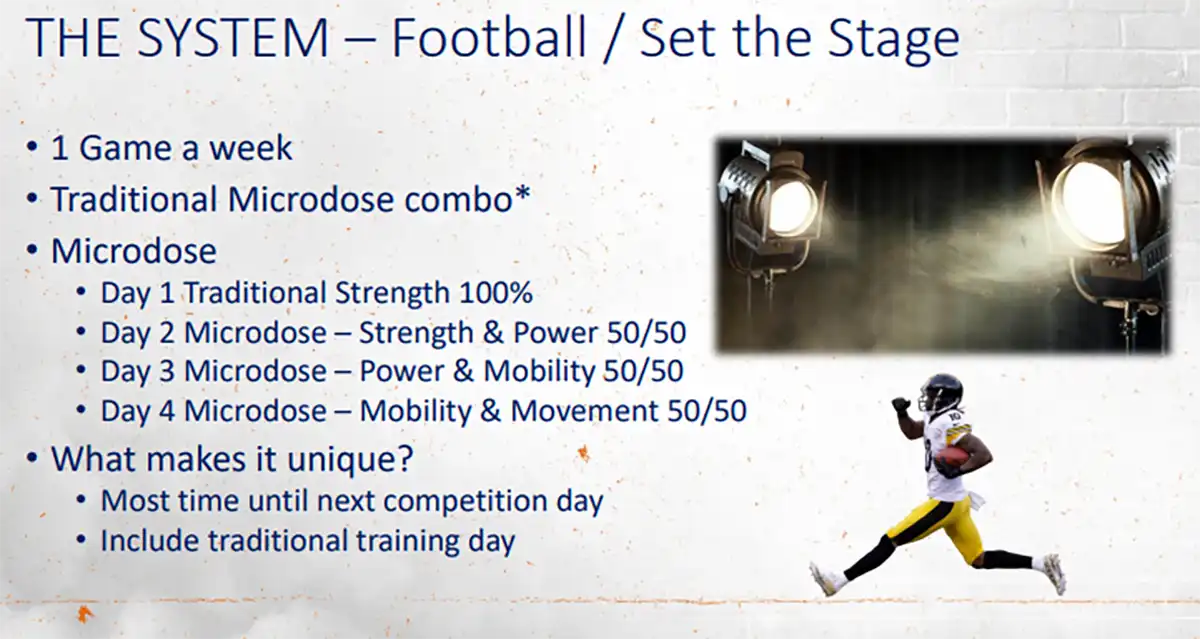
Microdosing Football

Key Emphases

  • High-force strength early in the week
  • Gradual shift toward power, mobility, and movement closer to game day
  • Larger recovery window between competitions
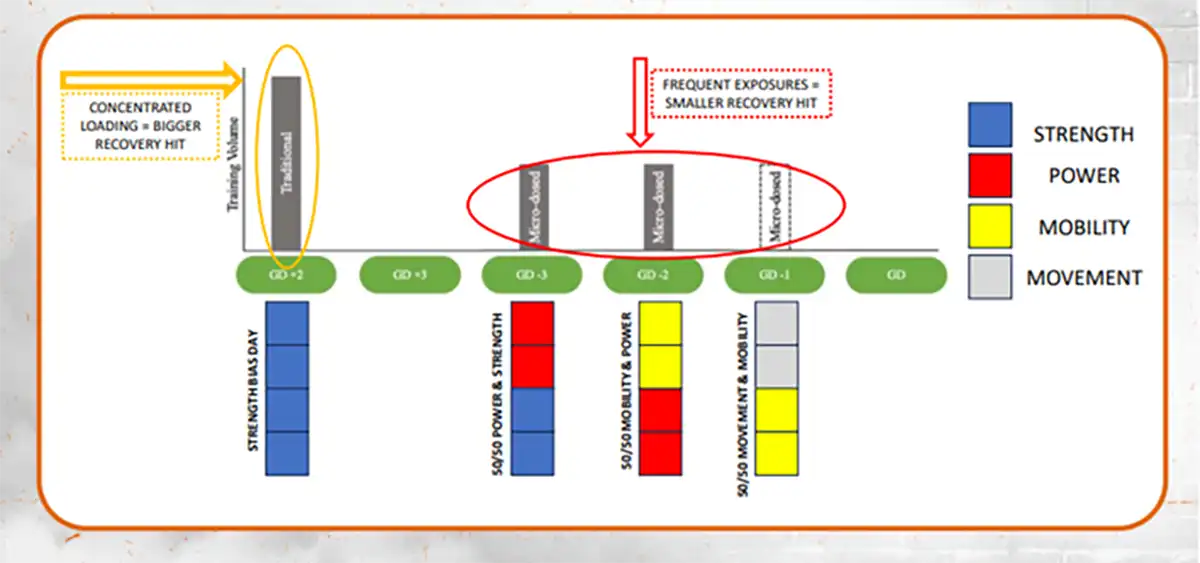
Microdosing Key Emphasis

Example Weekly Structure & Exercise Categories

Primary Strength Day (GD +2)

  • Squat variation
  • Heavy posterior chain (RDL or hinge variation)
  • Lower-body accessories
  • Heavy isometrics (when appropriate)

Strength & Power Microdose (Pre-Practice)

  • Trap bar pull or Olympic lift variation
  • Upper-body push (bench or variation)
  • Upper-body pull (row or chin-up)

Power & Mobility Microdose

  • Jump variations
  • Medicine ball throws
  • Targeted mobility or FRC-based work

Movement & Recovery (GD –1)

  • Flow-based movement
  • Soft tissue work
  • Body tempering

This structure allows meaningful loading early in the week while protecting readiness closer to competition.

Volleyball (2 Games per Week): True Microdosing Model

Volleyball schedules, particularly during conference play, are predictable, making them ideal for true microdosing and pre-practice exposures.
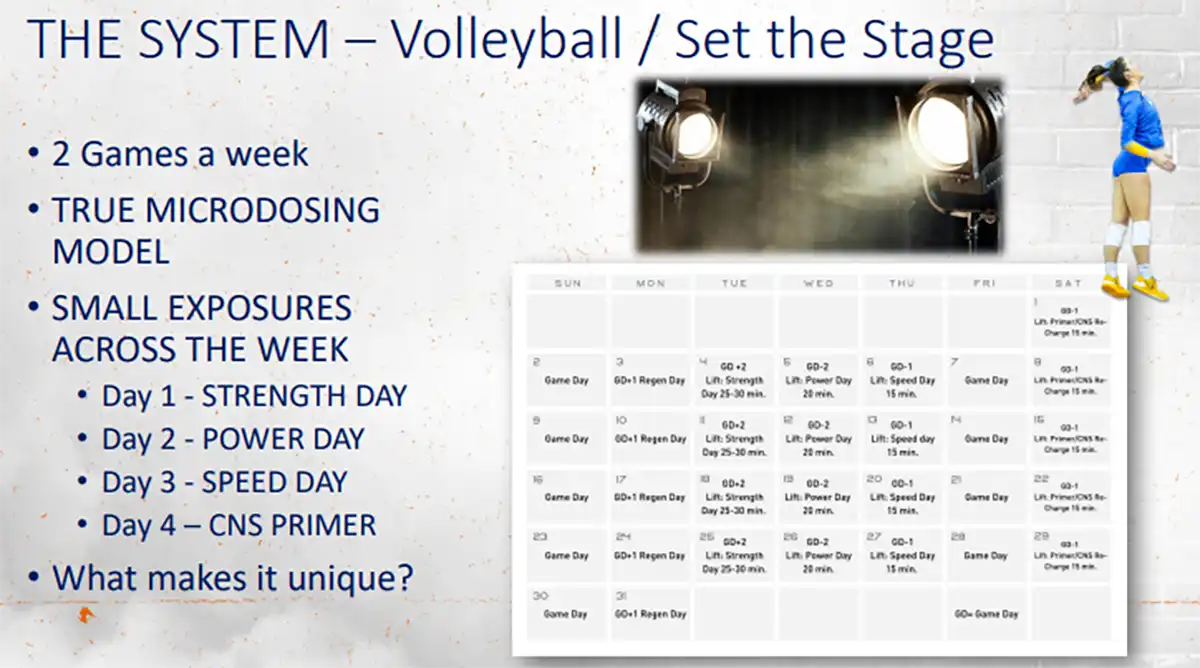
Microdosing Volleyball

Key Emphases

  • Frequent, short sessions (15–30 minutes)
  • Clear daily training themes
  • Strength further from competition, primers closer to match play
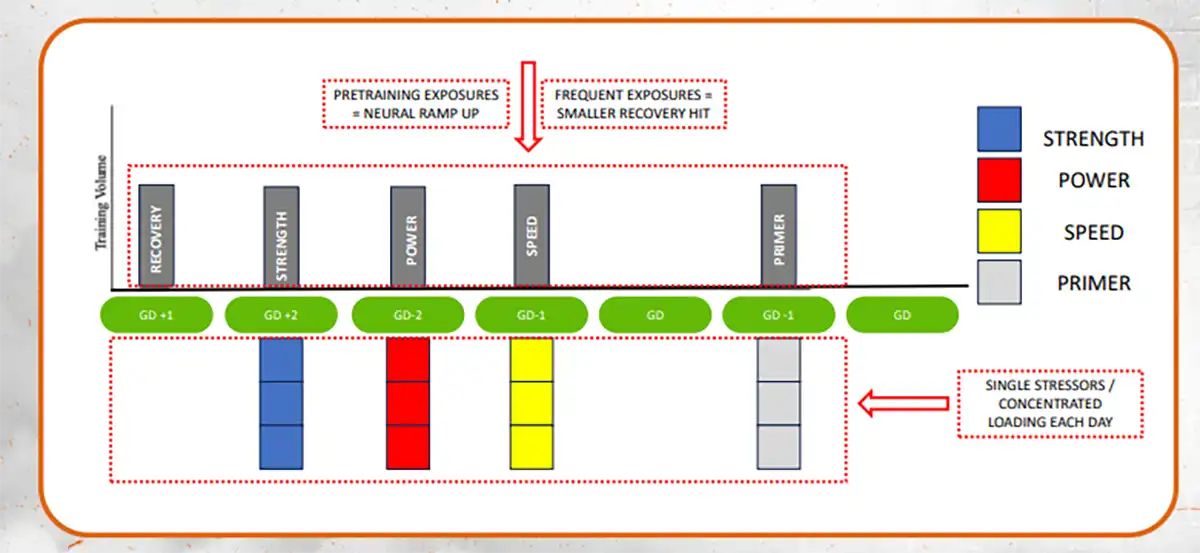
Microdosing Volleyball Key Emphasis

Example Weekly Structure & Exercise Categories

Monday – Regeneration

  • Mobility circuits
  • Soft tissue work
  • Light aerobic recovery

Tuesday – Strength (25–30 min)

  • Clean variation
  • Squat pattern
  • Nordic hamstring work

Wednesday – Power & Accessory (20–25 min)

  • Trap bar concentric pulls
  • Unilateral lower-body work
  • Upper-body accessories

Thursday – Speed (15 min)

  • Loaded jumps
  • Medicine ball throws or slams

Saturday – CNS Primer (15 min)

  • Speed cleans
  • Box jumps
  • Accelerated or reactive jumps

Frequent neuromuscular exposures allow athletes to train when fresh while limiting residual fatigue across the competitive week.

Baseball (6–7 Games per Week): Fluid Microdosing

Baseball presents the most complex in-season environment due to daily games, variable durations, extensive travel, and inconsistent recovery. Rather than rigid weekly plans, baseball requires fluid microdosing and a menu-based approach.
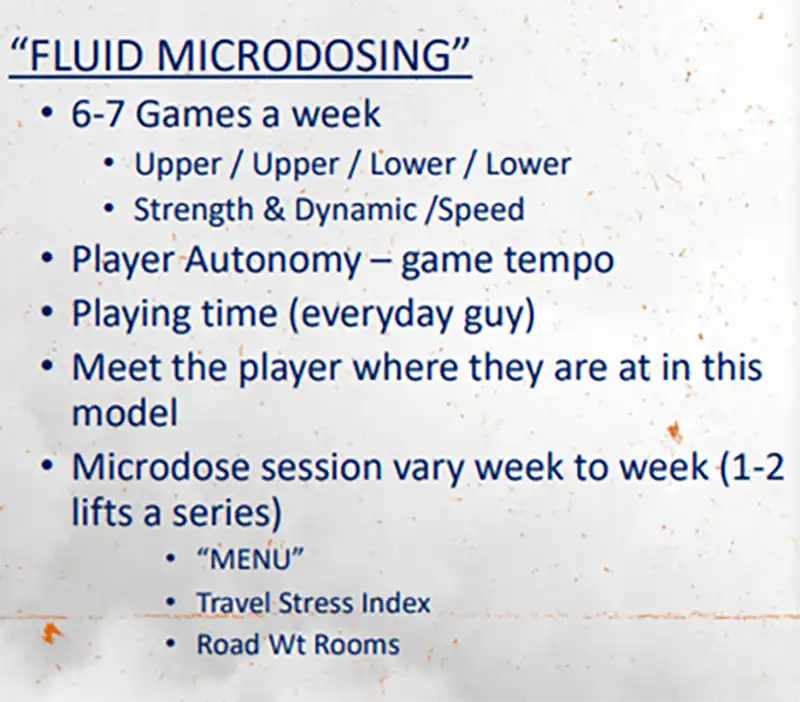
Fluid Microdosing

Key Emphases

  • Adaptability over fixed scheduling
  • Upper/lower alternation
  • Speed, mobility, and maintenance
  • Strong coach–athlete communication and trust
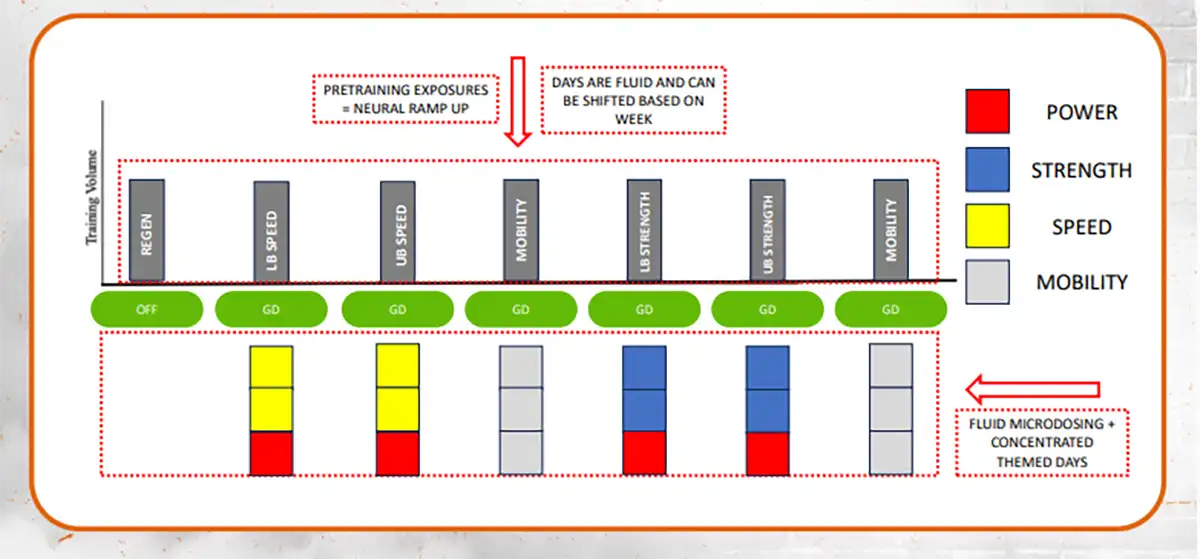
Microdosing Menu

Example Microdose Menu & Exercise Categories

Lower Body – Speed / Knee-Dominant

  • Jump variations
  • Knee-dominant hamstring work
  • 3D lunge patterns
  • Core and mobility

Upper Body – Horizontal Emphasis

  • Horizontal push
  • Dynamic horizontal push
  • Upper-back work
  • Vertical pull
  • Grip work and loaded carries

Lower Body – Hip-Dominant

  • Split squat or trap bar variation
  • Hip-dominant posterior chain
  • Groin work
  • Foot and calf training
  • Core or mobility

Upper Body – Vertical / Rotational

  • Vertical push
  • Rotational medicine ball throws
  • Horizontal row
  • Scapular and upper-back work
  • Arm care

Regeneration / Isometric Days

  • Mobility-focused sessions
  • Isometrics
  • Low-intensity movement and tissue work

Days shift based on readiness, travel, playing time, and accumulated workload.

Monitoring: The Backbone of Microdosing

Microdosing creates frequent opportunities to monitor performance and fatigue. Monitoring performance and fatigue ensures we apply the proper stimulus and adapt to the training load. Microdosing is the perfect time to implement frequent and varied testing across the week because we see the athletes more frequently in training. More training sessions equal more opportunities to test.

Force plate testing is the backbone of our performance testing. Monitoring jump height, RSI, and jump strategy is a very effective way for us to monitor general physical underpinning qualities, notably in volleyball.

Gymaware and velocity-based technology is the second biggest arm of the performance monitoring we utilize. When in-season and lifting daily, we must program and fluctuate training based on athlete readiness. By prescribing training session loads based on velocities, we can account for normal peaks and valleys in readiness.

RPE and wellness questionnaires are great monitoring tools regarding fatigue and readiness. By being consistent and quantifying perceived readiness variables, we get a more complete picture of where the athlete is in comparison to performance metrics and training loads. This helps us close the loop on monitoring the different areas of health and wellness.
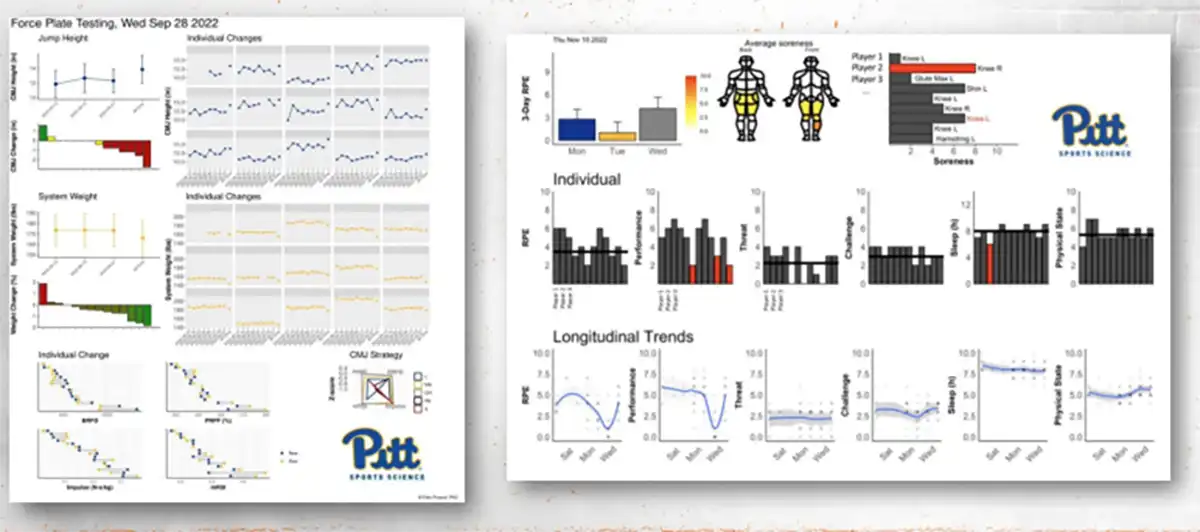
Force Plate Testing

Because we see athletes more often, coaches gain a clearer picture of daily readiness, response to load, and trends across the week, basing training decisions on data rather than assumptions.

Final Thoughts

Microdosing has become one of the most effective tools I’ve used for in-season physical preparation. It allows coaches to maintain high training standards while respecting the realities of competition, travel, and fatigue. The frameworks outlined here are not rigid templates, but adaptable decision-making models designed to solve real-world constraints. When applied with intention, communication, and trust, microdosing becomes more than a strategy; it becomes a sustainable system for in-season success.
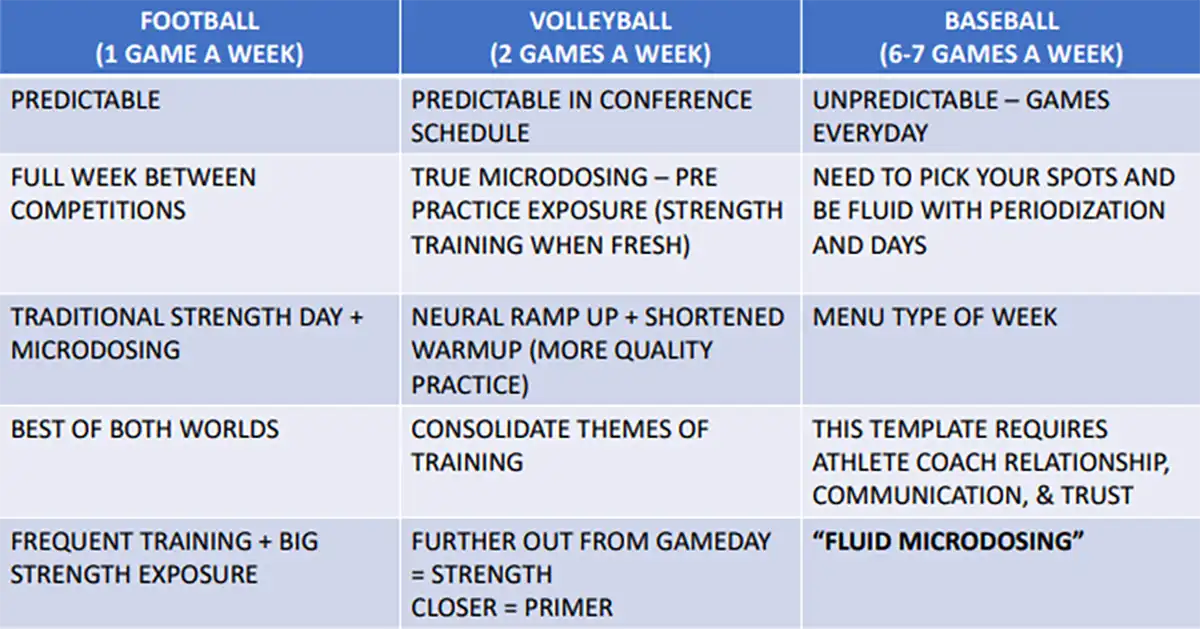

Microdosing Sport Comparison

Author

  • Stephanie Grubbs

    Stephanie Grubbs was hired by the Astros as assistant strength and conditioning coach in January of 2025. She brings several years of experience in the strength and conditioning field in the college
    ranks.

    Prior to joining the Astros, Grubbs had served as assistant athletic director for sports performance at the University of Pittsburgh since June of 2021. While at Pitt, she worked with several successful programs, including their women’s volleyball team that won three consecutive ACC championships (2022-24).

    Before joining the Pitt Panthers, she was the director of Olympic sports strength and conditioning for Mississippi State University from July of 2018-May of 2021.

    Grubbs’ also spent five seasons working for Clemson University (2013-18), where she started as an intern before advancing to assistant strength and conditioning coach in 2016 and then assistant director of Olympic sports strength and conditioning in 2017.

    Additionally, Grubbs’ experience includes a stint as a seasonal strength and conditioning/sports science intern with the Pittsburgh Steelers from July of 2022-January of 2023.

    In 2022, she was awarded the title of Master International Strength and Conditioning Practitioner by the International Universities Strength and Conditioning Association.

    She earned a bachelor of science degree in physical activity and sports sciences from West Virginia University in 2013, earning Big East All-Academic Team honors from 2009-11.

    Grubbs later would earn her master’s degree in athletic leadership/human resource development from Clemson University in 2016.
    Grubbs resides in Houston with her husband, Ryan Grubbs, who serves as the Houston Texans director of reconditioning return to football and speed development.

    View all posts

Leave the first comment

Microdosing In-Season Training
Table of Contents

Microdosing In-Season Training: Practical Frameworks for Managing Load, Fatigue, and Performance

Share this

Summary

The tension between sport demands and physical preparation is where many in-season programs struggle, and where microdosing becomes a powerful tool. Rather than asking how much work an athlete can handle, microdosing asks: What is the smallest effective dose we can apply today, and how frequently can we repeat it?

For strength and conditioning coaches, the off-season is often the most exciting time of year. This is when we can apply concentrated training loads, introduce meaningful stressors, and push physical qualities to new levels. Practice schedules are lighter, meetings are fewer, and competition-related fatigue is no longer the dominant constraint. Traditional strength training methodologies are not only applicable during this phase, and they are highly effective.

Then the in-season begins.

Training time is limited. Athlete availability fluctuates. Travel, practices, meetings, competitions, and academic or personal demands all compete for space in the weekly schedule. In many team sport environments, strength coaches are allotted only one to two training days per week. In some cases, there is no consistent training time at all, resulting in sporadic or reactive sessions.

This tension between sport demands and physical preparation is where many in-season programs struggle, and where microdosing becomes a powerful tool.

Where the Concept of Microdosing Took Shape

I first heard the term microdosing at the Sacramento Kings Performance Symposium in 2018. Cory Schlesinger was presenting on the Stanford Men’s Basketball program and described how training themes, exercise selection, and daily intent were organized across the week.

What stood out was not simply the exercises, but the framework. Each day had a clear purpose. Training stress was distributed across the week instead of being concentrated into one or two sessions. The system acknowledged the realities of in-season sport while still prioritizing physical development.

That approach gave me the foundation to begin developing my own in-season models.

Defining Microdosing

Microdosing is not simply “doing less.”

Clear definition:

Microdosing is the division of total training volume within a microcycle across frequent, short-duration bouts (Cuthbert et al., 2024).

Comparison of Traditional and Micro-dosed Training Schedules

The objective is to expose athletes to meaningful stimuli more often, while keeping the acute cost of each session low enough to avoid compromising practice quality or game readiness on that day.

Rather than asking, “How much can we do today?”

Microdosing asks, “What is the smallest effective dose we can apply today, and how frequently can we repeat it?”

Why Apply Microdosing In-Season?

Constraints define in-season training:

  • Competition schedules
  • Travel demands
  • Practice volume
  • Meetings and media obligations
  • Athlete fatigue and readiness
  • Limited access to facilities

Microdosing allows coaches to train within these constraints instead of constantly fighting against them. By spreading training stress across the week, coaches gain:

  • More frequent exposures to load
  • Improved monitoring of readiness
  • Higher-quality movement execution
  • Increased athlete availability
  • Stronger buy-in and training culture

Higher frequency does not mean higher fatigue; it means better managed fatigue.

Pre-Practice Exposure: Elevating Readiness

One of the most impactful shifts I made was moving training before practice. Instead of a low-level general warm-up on the court or field, athletes spend 15–30 minutes in the weight room receiving a specific neuromuscular stimulus designed to elevate readiness.

This approach:

  • Acts as a neural ramp-up
  • Shortens traditional warm-ups
  • Improves practice quality
  • Allows athletes to train when they are freshest

The result is not simply better training; it is better practice.

Travel as a Training Opportunity

Travel presents one of the biggest challenges in team sport performance. Upon arrival (whether by plane or bus), movement becomes medicine. A short, intentional training session can:

  • Restore rhythm
  • Improve circulation
  • Re-establish joint range of motion
  • Prime the central nervous system for practice

Coming out flat during travel practices is a common issue. Microdosing provides a tool to elevate readiness and close that gap.

Why Microdosing Works

Both research and applied practice support several benefits of microdosing:

  • Minimal effective dose training
  • More efficient warm-ups
  • Frequent readiness assessment
  • Higher-quality movement due to fewer exercises per session
  • Improved coach–athlete relationships
  • Increased athlete availability
  • Favorable hormonal responses, particularly in female athletes
  • Reinforcement of training importance within team culture
Pros and Cons of Microdosing In-Season Training

Practical Application: Exercise Selection by Sport

The following examples illustrate how training themes and exercise categories can be layered into microdosed frameworks based on competition demands. These are not rigid templates, but decision-making models.

Football (1 Game per Week): Traditional + Microdose Hybrid

With one competition per week, football allows for a hybrid approach that blends one concentrated strength exposure with several microdosed sessions.

Microdosing Football

Key Emphases

  • High-force strength early in the week
  • Gradual shift toward power, mobility, and movement closer to game day
  • Larger recovery window between competitions

Microdosing Key Emphasis

Example Weekly Structure & Exercise Categories

Primary Strength Day (GD +2)

  • Squat variation
  • Heavy posterior chain (RDL or hinge variation)
  • Lower-body accessories
  • Heavy isometrics (when appropriate)

Strength & Power Microdose (Pre-Practice)

  • Trap bar pull or Olympic lift variation
  • Upper-body push (bench or variation)
  • Upper-body pull (row or chin-up)

Power & Mobility Microdose

  • Jump variations
  • Medicine ball throws
  • Targeted mobility or FRC-based work

Movement & Recovery (GD –1)

  • Flow-based movement
  • Soft tissue work
  • Body tempering

This structure allows meaningful loading early in the week while protecting readiness closer to competition.

Volleyball (2 Games per Week): True Microdosing Model

Volleyball schedules, particularly during conference play, are predictable, making them ideal for true microdosing and pre-practice exposures.

Microdosing Volleyball

Key Emphases

  • Frequent, short sessions (15–30 minutes)
  • Clear daily training themes
  • Strength further from competition, primers closer to match play

Microdosing Volleyball Key Emphasis

Example Weekly Structure & Exercise Categories

Monday – Regeneration

  • Mobility circuits
  • Soft tissue work
  • Light aerobic recovery

Tuesday – Strength (25–30 min)

  • Clean variation
  • Squat pattern
  • Nordic hamstring work

Wednesday – Power & Accessory (20–25 min)

  • Trap bar concentric pulls
  • Unilateral lower-body work
  • Upper-body accessories

Thursday – Speed (15 min)

  • Loaded jumps
  • Medicine ball throws or slams

Saturday – CNS Primer (15 min)

  • Speed cleans
  • Box jumps
  • Accelerated or reactive jumps

Frequent neuromuscular exposures allow athletes to train when fresh while limiting residual fatigue across the competitive week.

Baseball (6–7 Games per Week): Fluid Microdosing

Baseball presents the most complex in-season environment due to daily games, variable durations, extensive travel, and inconsistent recovery. Rather than rigid weekly plans, baseball requires fluid microdosing and a menu-based approach.

Fluid Microdosing

Key Emphases

  • Adaptability over fixed scheduling
  • Upper/lower alternation
  • Speed, mobility, and maintenance
  • Strong coach–athlete communication and trust

Microdosing Menu

Example Microdose Menu & Exercise Categories

Lower Body – Speed / Knee-Dominant

  • Jump variations
  • Knee-dominant hamstring work
  • 3D lunge patterns
  • Core and mobility

Upper Body – Horizontal Emphasis

  • Horizontal push
  • Dynamic horizontal push
  • Upper-back work
  • Vertical pull
  • Grip work and loaded carries

Lower Body – Hip-Dominant

  • Split squat or trap bar variation
  • Hip-dominant posterior chain
  • Groin work
  • Foot and calf training
  • Core or mobility

Upper Body – Vertical / Rotational

  • Vertical push
  • Rotational medicine ball throws
  • Horizontal row
  • Scapular and upper-back work
  • Arm care

Regeneration / Isometric Days

  • Mobility-focused sessions
  • Isometrics
  • Low-intensity movement and tissue work

Days shift based on readiness, travel, playing time, and accumulated workload.

Monitoring: The Backbone of Microdosing

Microdosing creates frequent opportunities to monitor performance and fatigue. Monitoring performance and fatigue ensures we apply the proper stimulus and adapt to the training load. Microdosing is the perfect time to implement frequent and varied testing across the week because we see the athletes more frequently in training. More training sessions equal more opportunities to test.

Force plate testing is the backbone of our performance testing. Monitoring jump height, RSI, and jump strategy is a very effective way for us to monitor general physical underpinning qualities, notably in volleyball.

Gymaware and velocity-based technology is the second biggest arm of the performance monitoring we utilize. When in-season and lifting daily, we must program and fluctuate training based on athlete readiness. By prescribing training session loads based on velocities, we can account for normal peaks and valleys in readiness.

RPE and wellness questionnaires are great monitoring tools regarding fatigue and readiness. By being consistent and quantifying perceived readiness variables, we get a more complete picture of where the athlete is in comparison to performance metrics and training loads. This helps us close the loop on monitoring the different areas of health and wellness.

Force Plate Testing

Because we see athletes more often, coaches gain a clearer picture of daily readiness, response to load, and trends across the week, basing training decisions on data rather than assumptions.

Final Thoughts

Microdosing has become one of the most effective tools I’ve used for in-season physical preparation. It allows coaches to maintain high training standards while respecting the realities of competition, travel, and fatigue. The frameworks outlined here are not rigid templates, but adaptable decision-making models designed to solve real-world constraints. When applied with intention, communication, and trust, microdosing becomes more than a strategy; it becomes a sustainable system for in-season success.

Microdosing Sport Comparison

Author

  • Stephanie Grubbs

    Stephanie Grubbs was hired by the Astros as assistant strength and conditioning coach in January of 2025. She brings several years of experience in the strength and conditioning field in the college
    ranks.

    Prior to joining the Astros, Grubbs had served as assistant athletic director for sports performance at the University of Pittsburgh since June of 2021. While at Pitt, she worked with several successful programs, including their women’s volleyball team that won three consecutive ACC championships (2022-24).

    Before joining the Pitt Panthers, she was the director of Olympic sports strength and conditioning for Mississippi State University from July of 2018-May of 2021.

    Grubbs’ also spent five seasons working for Clemson University (2013-18), where she started as an intern before advancing to assistant strength and conditioning coach in 2016 and then assistant director of Olympic sports strength and conditioning in 2017.

    Additionally, Grubbs’ experience includes a stint as a seasonal strength and conditioning/sports science intern with the Pittsburgh Steelers from July of 2022-January of 2023.

    In 2022, she was awarded the title of Master International Strength and Conditioning Practitioner by the International Universities Strength and Conditioning Association.

    She earned a bachelor of science degree in physical activity and sports sciences from West Virginia University in 2013, earning Big East All-Academic Team honors from 2009-11.

    Grubbs later would earn her master’s degree in athletic leadership/human resource development from Clemson University in 2016.
    Grubbs resides in Houston with her husband, Ryan Grubbs, who serves as the Houston Texans director of reconditioning return to football and speed development.

    View all posts

Leave the first comment

Browse By Brand

User Guide Filter

Browse By Categories

Browse By Topics

Category Filter

Contents

Browse By Topics

Topic Filter